Table of Contents
Estimated reading time: 22 minutes
Key Takeaways
- Parking garage collisions often have multiple potential defendants and fast-overwriting video, so act within 24–72 hours to preserve evidence.
- Security camera footage can decide fault but is frequently deleted within days; send preservation letters immediately and follow up in writing.
- Fault can fall on drivers, garage owners/operators, valet/security, contractors, or public entities depending on negligence and control of the hazard.
- Build the case with layered proof: footage, photos (with timestamps), witness statements, maintenance logs, and vehicle black-box (EDR/ECM) data.
- If liability stays disputed or insurers lowball, file a hit in parking structure lawsuit within the statute of limitations after targeted discovery.
If you’re dealing with a parking garage car accident claim, act quickly — evidence like surveillance footage can disappear in days and liability is often unclear.
Parking structures create unique risks: blind corners, narrow ramps, poor lighting, and multiple parties responsible for safety. Cases can involve several defendants and video systems that routinely overwrite footage, which makes early action critical. This guide explains exactly what to do in the first 24–72 hours, how to lock down surveillance, who may be liable, and when to sue if insurers won’t treat you fairly. We know you’re hurting and overwhelmed; the steps below are designed to reduce stress and protect your health, rights, and recovery. Many parking-lot liability questions and overwriting risks are well documented by practical guides on parking-lot liability and evidence preservation and California-specific overviews of who may be liable.
This article is for drivers, passengers, and pedestrians who were hit in a parking garage and need legal guidance, evidence-preservation steps, or representation. The search intent here is clear: find practical parking deck collision legal advice and representation when fault is unclear and surveillance footage may vanish.
Immediate Steps After a Parking Garage Accident (24–72 Hour Checklist)
In the first hours after a parking garage car accident claim event, focus on safety, medical care, documentation, and preservation of security footage. Many of these steps are emphasized in California-focused resources about parking-lot injuries and reporting and broader guides to parking-lot liability and proof.
Safety and medical care
- Check for injuries and call emergency services if anyone is hurt. Even minor symptoms can mask soft-tissue or head injuries.
- Seek medical evaluation as soon as possible and follow through on care; keep records and discharge instructions for every visit. Medical documentation connects injuries to the crash and supports damages. See the California-oriented guidance on reporting and treatment after parking-lot incidents.
Scene preservation and photos
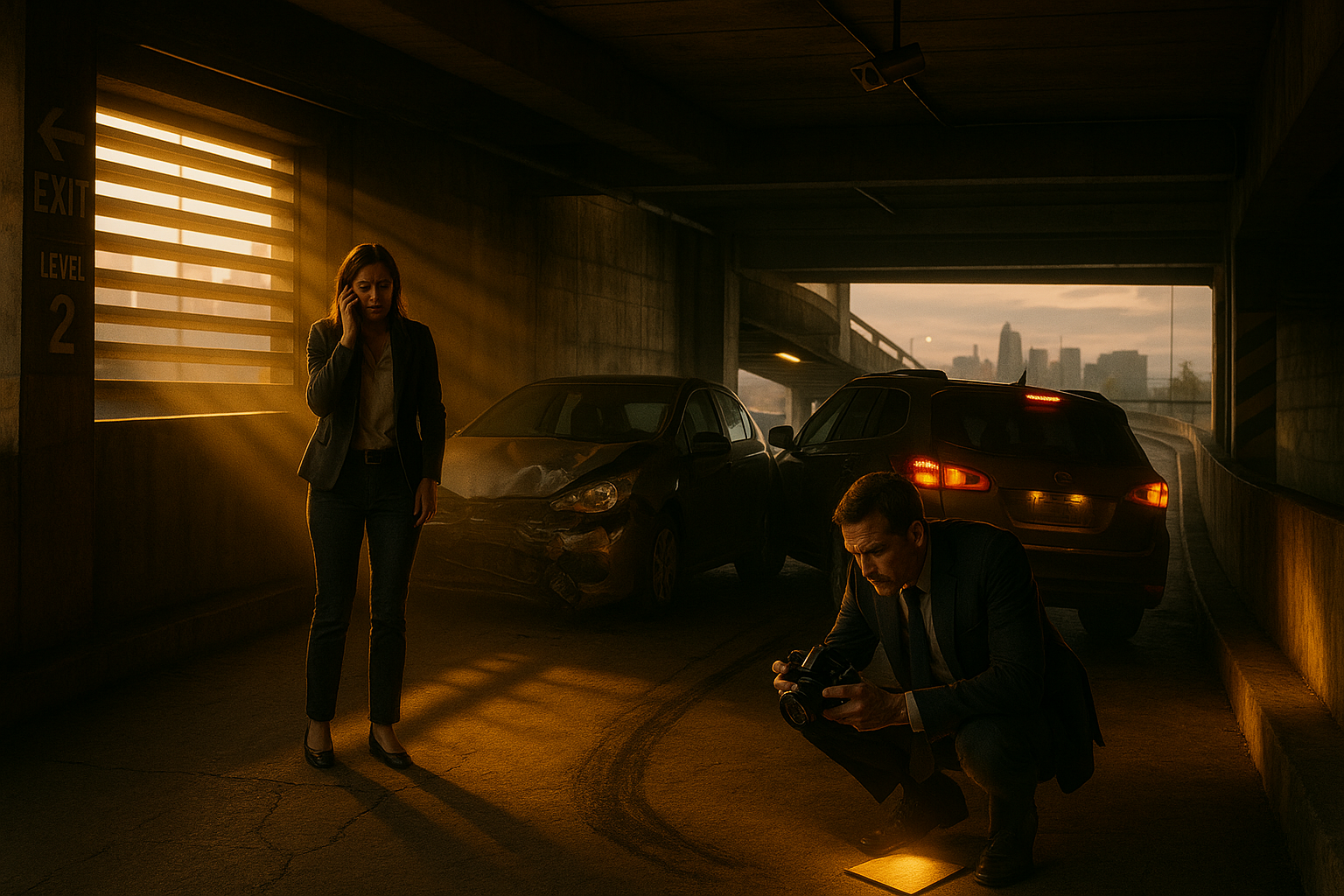
- Photograph vehicle positions, damage (wide and close-up), skid marks, ramp geometry (width, clearances), turning radii, lighting levels, signage, pavement defects, mirrors, and any debris.
- Enable location and date settings in your phone/camera so EXIF metadata embeds timestamps/GPS in original files. Keep originals, not edited exports.
- Practical examples of what to capture in lots/garages appear in parking-lot liability checklists and California-focused hazard overviews.
If you want a deeper photography walkthrough for claim-strengthening, see our step-by-step guide on documenting vehicle damage with photos.
Witnesses and onsite personnel
- Collect witness names, phone numbers, and a brief written or recorded statement while memories are fresh.
- Note on-duty security, valet, or garage manager names and badge numbers. Ask who oversees incident reporting and surveillance.
- These practical witness steps are echoed in parking lot liability guides and our focused resource on using witnesses effectively in car accident claims.
Reporting the incident
- Report the incident to facility management/security and request an incident or accident report number.
- If injuries or significant damage occurred, call the police and get a police report; reports often anchor insurer decisions. Learn how to use and correct police reports in our California police-report guide.
- California-oriented sources recommend prompt reporting for parking-lot injuries; see this overview of who may be liable.
Immediate video preservation
- Ask staff to preserve surveillance footage for the relevant date/time and write down every camera you see (ramp entrance, pay kiosk, chokepoints, elevators).
- Note the date/time precisely. Many systems overwrite within days; preservation requests in the first 24–48 hours are essential, as highlighted by practical preservation guides.
For more context on fault in private lots and structures, see our explainer on who is at fault in a parking-lot crash.
How to Preserve Security Camera Evidence Parking Garage Accident
Security camera evidence in a parking garage accident can be the most decisive proof of fault. Many systems automatically overwrite within 7–30 days—sometimes sooner—so speed is your ally. This overwrite reality and the need for same-day requests are reinforced by parking-lot liability and evidence guides.
Why video matters and what to do now
- Video captures approach speeds, right-of-way, lighting, sightlines, and evasive actions—details that resolve he-said/she-said disputes.
- Make a verbal request to management immediately, then send a written preservation letter the same day. Obtain written confirmation.
- Ask for policies on retention (how many days before overwrite), available camera IDs/locations, and native export options.
Sample preservation-letter language
Copy, paste, and customize this exact language into your email or letter (send within 24–48 hours):
[Date]
To: [Garage Manager/Operator Name & Address]
Re: Preserve all video and related evidence for incident on [Date] at approximately [Time] involving vehicle(s) [make/model and plate numbers]
Please preserve all video recordings, system logs, backup tapes, and any associated metadata from all cameras and recording devices covering the facility from [Time minus 30 minutes] through [Time plus 30 minutes]. Preservation must include original files, not compressed exports. Failure to preserve this evidence may subject you to sanctions.
Kindly confirm in writing by [Date] that preservation is in place and advise on the system’s retention period, camera IDs/locations covering the area, and the format in which native files can be exported.
Sincerely,
[Your Name/Contact]
Process tips echoed by practical preservation sources include: ask for exact camera locations, request native-format exports (not just compressed clips), and require written confirmation.
If management won’t preserve
If the owner/operator refuses or remains noncommittal, your lawyer can quickly pursue a subpoena or an emergency preservation order. Guidance on urgent subpoenas and court-backed preservation appears in parking-lot litigation resources. Also consider alternate digital proof while video is pending or absent, such as phone app data that corroborates timelines and movement; see our deep dive on using phone and app data in car accident claims.
Preservation letters vs. subpoenas
A preservation letter requests a voluntary hold on evidence; a subpoena compels production in litigation. Send the preservation letter within 24–48 hours and, if necessary, follow with formal process once a case is filed. Practical distinctions and timing are emphasized in parking-lot claim guides.
Subpoena outline (for attorney drafting; not a legal form):
- Recipient: Owner/operator, security vendor, or third-party video host.
- Scope: All video covering [date/time window], native files plus metadata, audit trails, access logs, retention policies, maintenance/repair logs of cameras/servers.
- Specificity: Identify camera IDs, locations (entrances, ramps, pay stations), and any mirrored storage or backups.
- Chain of custody: Export logs, hash values, and descriptions of conversion tools if used.
- Deadlines: Short response time to beat overwrite windows.
Other documentary evidence you need (and how to get it)
Build redundancy: if one piece is missing, others can still prove liability. The following items, with action steps, are commonly cited in parking-lot liability resources and California-focused liability overviews (evidence types; premises duties):
- Maintenance/inspection logs. Request from the owner/manager to show notice of hazards (lighting outages, faded markings, malfunctioning mirrors) and whether timely repairs occurred.
- Lighting/signage plans and photographs. Document dim areas, missing bulbs, poorly placed signs, or faded arrows that confuse drivers.
- Security/alarm logs, valet tickets, gate/barrier data. Electronic logs can reveal vehicle movements and staffing at chokepoints; seek in native format. See guidance in parking-lot log sources.
- Vehicle ECM/black box data (EDR). Preserve the vehicle promptly and work with a qualified technician to download speed, braking, and throttle data; see our primer on black box (EDR) evidence and general references to black-box value in parking-lot investigations.
- EXIF-backed photos. Keep original image files with timestamps and geotags intact; avoid filters/edits that strip metadata.
- Witness statements. Obtain signed or recorded statements as soon as possible; see our step-by-step guide to using witness statements in claims.
Where each piece fits into proving fault
- Footage: Pinpoints sequence-of-events and primary fault.
- Maintenance logs: Show owner/operator notice and negligence (duty and breach).
- Lighting/signage/photos: Prove dangerous conditions and failure to warn.
- ECM/EDR data and skid marks: Establish speed, reaction, and stopping distance.
- Witness statements: Corroborate timelines and fill blind spots when video is incomplete.
These mappings align with practical proof strategies in parking-lot liability resources. If you’re compiling a full claim package, consider the broader steps and timing set out in our auto accident claim process guide.
Common Parking Garage Crash Scenarios and What They Mean for Liability
Narrow ramp collisions
Single-lane ramps, blind corners, low ceilings, and tight turning radii make sideswipes and head-on contacts foreseeable. Liability can turn on design choices and warnings (mirrors, convex mirrors, mirrors’ maintenance), as well as driver behavior. Evidence priorities include ramp dimensions, turning radii, sightline obstructions, prior complaints, and cameras at the curve—topics echoed in analyses of California parking lot accidents and ramp design risks. If you’re pursuing a narrow ramp crash claim, collect both engineering and maintenance proof early.
Multi-level deck chokepoint crashes
Entry/exit bottlenecks, grade changes, merging lanes, and faded markings often trigger rear-ends, merges, and sideswipes. Liability may involve driver negligence and premises negligence for poor flow design or faded markings. Evidence targets include traffic-flow design, upkeep of paint/markings, and lighting at entries/exits; these failure modes appear in liability guides for lots/garages and California-centric overviews of who may be liable in Los Angeles parking lots.
Hit-and-run and negligent security
Dark garages without patrols or adequate lighting increase risk of hit-and-runs, assaults, thefts, and valet misconduct. Proving negligent security typically involves security logs, incident reports, lighting maintenance, and prior complaints—evidence categories discussed in California parking-lot liability overviews such as who may be liable. In hit-and-run scenarios, use UM coverage and pair witness canvassing with any available camera footage; learn how to structure claims without eyewitnesses in our resource for no-witness hit-and-run claims.
Short examples:
- Speeding around a blind corner on a narrow ramp leads to a head-on contact; video shows excessive entry speed and no horn/slow approach.
- “Dooring” on a tight spiral ramp where two lanes briefly narrow; faded centerline and missing yield signs are documented in photos.
- Valet strikes a parked car at a pay kiosk; camera and valet logs corroborate impact and timing.
Who Can Be Liable in a Parking Garage Crash — Legal Theories Explained
Most parking garage cases involve negligence and premises liability. To win, you must prove four elements: duty, breach, causation, and damages. These fundamentals are outlined in actionable guides to parking-lot liability and in California-specific discussions of who may be liable.
Potentially liable parties and legal bases
- Drivers. Ordinary negligence for speeding, failure to yield, inattention, or unsafe backing. See general driver-fault explanations in driver fault overviews and parking-lot fault primers.
- Property owners/operators. Premises liability for dangerous conditions: poor maintenance, deficient design, inadequate lighting/signage, or lack of mirrors. Evidence of notice is critical, as highlighted in premises negligence guides and California-focused owner/operator liability.
- Valet/security companies and employees. Vicarious liability for employee negligence within scope of employment; see duties discussed in garage liability resources.
- Maintenance contractors. Negligent repairs or failure to address known hazards; see California negligence discussions in premises liability overviews and Los Angeles parking-lot liability.
- Municipalities/public entities. Liability for structural defects or public garage hazards; strict notice and short deadlines often apply, as noted in public-entity claim sources.
Comparative negligence
In many states, your recovery is reduced by your share of fault. Example: $100,000 in damages with 20% fault yields an $80,000 net recovery. Some states are pure comparative; others are modified with cutoff thresholds. Practical explanations of comparative rules and California examples appear in parking-lot liability guides and California parking-lot accident primers. For a California-focused breakdown of shared-fault math, see our explainer on California comparative fault and payout calculations.
Insurance Claims After a Parking Garage Crash — What to Expect
Coverage usually involves personal auto (liability, UM/UIM) and potentially the garage’s commercial liability policy, as explained in practical insurance overviews. Many claims resolve pre-suit with well-organized evidence.
How insurers investigate
Insurers request recorded statements, photos, police and incident reports, and any footage. Common defenses include shared fault or denial that the owner owed a duty or had notice of the hazard. These patterns are discussed in lot-liability guides and California-focused insurer overviews like parking-lot accident law summaries.
Presenting your evidence
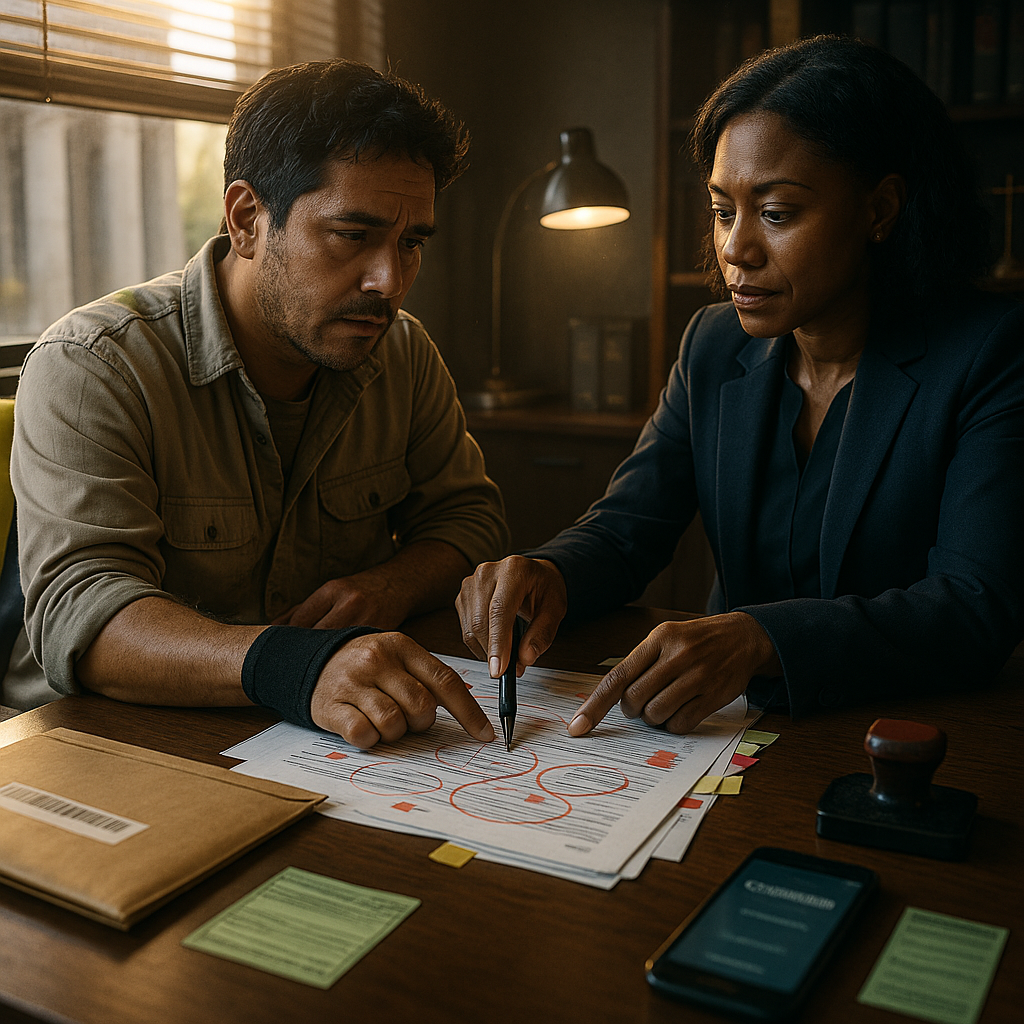
Send time-stamped native video files, maintenance logs, photos with EXIF data, witness contact information, and any EDR downloads as a complete package. Organize with a concise timeline and a demand letter. For a structured approach, see our resource on building a strong compensation claim package.
Settlement vs. litigation
Consider settlement when liability is clear and the offer fairly covers medical bills, lost wages, and pain/suffering. If offers are low, liability is disputed, or injuries need ongoing care, litigation may be the better path—as also advised in parking-lot litigation guides. For big-picture steps, our overview of the auto claim process can help you time demands and escalation.
When to File a Hit in Parking Structure Lawsuit — Process and Timeline
When insurers dispute fault or undervalue your losses, a lawsuit may be necessary. Typical causes of action include negligence (drivers), premises liability (owners/operators), negligent security (crime/inadequate lighting), and vicarious liability (valet/security staff)—categories discussed in parking-lot lawsuit guides.
Burden of proof and procedure
Civil cases require proof by a preponderance of the evidence (more likely than not), consistent with the practical explanations provided in litigation primers. Typical timeline: Pleadings/Service → Discovery (document requests, interrogatories, depositions, subpoenas for footage/logs/maintenance) → Motions → Trial. Filing deadlines vary widely, but many states use a 1–3 year window.
Damages and costs
Recoverable damages include vehicle repair, medical bills (past and future), lost wages/earning capacity, and pain and suffering. Lawyers commonly work on contingency, advancing most case costs and getting paid only if you recover—practices noted in consumer-focused litigation guides and California resources on premises liability.
Claims Based on Garage Design & Structure (Narrow Ramps, Lighting, Signage)
Narrow ramp crash claim (design defect/failure to warn)
Some cases argue that design defects or failure to warn created a foreseeable risk. Elements often include unsafe layout, notice/constructive knowledge, causation, and damages. Evidence includes ramp width and turning radius measurements, original design plans, complaint history, and expert engineering opinions. These strategies are explored in California-focused analyses of parking lot accidents and design issues.
Lighting, signage, and markings (negligence theory)
Inadequate lighting, faded markings, unclear signage, and improper grades can constitute negligence. Support your theory with photometric studies, accident reconstruction, and maintenance records to show breach and causation. These methods are reflected in lot-liability resources and in California analyses of sightline/lighting hazards.
If expert testimony will be pivotal—accident reconstructionists, civil/structural engineers, or medical experts—review how experts move the needle in our primer on using expert witnesses in car accident claims.
Common Defense Tactics and How to Counter Them
“No video/overwritten footage”
Defense: Video doesn’t exist or was overwritten. Counter: Produce early preservation requests, retention policies, export logs, and alternate proof (witness statements, EXIF-stamped photos, EDR). If the owner destroyed evidence after notice, seek spoliation sanctions; practical frameworks appear in parking-lot litigation guides.
“Shared fault/comparative negligence”
Defense: Plaintiff contributed to the crash. Counter: Use video timelines, reconstruction, and EDR speed/braking data to apportion fault fairly. Comparative negligence science and examples are discussed in liability guides.
“No notice to owner”
Defense: Owner/operator had no notice of the hazard. Counter: Produce prior complaints, maintenance logs, inspection reports, and similar-incident data to show constructive notice—approaches emphasized in premises liability materials.
“Open-and-obvious hazard”
Defense: The hazard was obvious; no duty to warn. Counter: Show how design choices (tight turns, inadequate mirrors) and poor lighting made the hazard effectively hidden. Use eyewitness accounts and sightline analyses; these arguments are consistent with premises negligence frameworks.
Critical Deadlines: What to Do in the First 24–72 Hours, 2 Weeks, and 1–3 Months
First 24–72 hours
- Seek medical care, photograph the scene and damages, collect witness contacts, report to management/police, and send a surveillance preservation letter. These fast steps are stressed in California parking-lot injury guides and parking-lot liability resources.
- If no officer responds, learn how to document and proceed anyway with our concise guide to a no-police-report claim.
First 2 weeks
- Collect medical records, schedule follow-up imaging, request maintenance/inspection logs, and consider counsel to issue subpoenas or urgent preservation orders as needed—actions echoed in California-focused liability checklists.
Month 1–3
- Send a demand letter, negotiate with insurers, and have your attorney continue investigation (experts, subpoenas, depositions) or file suit if deadlines loom. These steps are outlined in California resources and parking-lot litigation guides.
Statutes of limitations
Deadlines vary by state and by claim type; as an example, California personal injury claims are generally two years, with special rules for public-entity claims. See a state-law overview in this summary. For California-specific timing and exceptions, review our resource on the car accident statute of limitations.
How a Parking-Structure Injury Attorney Can Help — What to Expect and Ask
Experienced counsel moves fast to preserve video and build a layered case. Common early tasks include issuing preservation letters, drafting subpoenas, coordinating native video exports, and securing logs from owners/operators and vendors. Evidence and negotiation strategies emphasized in parking-lot liability guides often require coordinated expert input.
Concrete attorney tasks
- Issue preservation letters and subpoenas for footage/logs immediately.
- Retain experts: accident reconstructionist, civil/structural engineer, forensic video analyst, ECM/black-box specialist.
- Negotiate with insurers, prepare pleadings, handle discovery, and try the case if necessary.
- Calculate damages, including future medicals, lost earning capacity, and non-economic losses.
Questions to ask potential counsel
- Have you handled hit in parking structure lawsuit cases before? How many, and what were the outcomes?
- Do you work on contingency? What is the percentage, and are case costs advanced?
- How quickly will you send preservation letters and subpoenas?
Red flags
- No local experience with garages or premises liability.
- Large upfront fees without a clear, urgent plan to preserve footage.
For broader context on the claim path and how legal teams guide you through it, see our resource on mastering the auto accident claim process and actionable tips for claim presentation.
Practical Checklists & Preservation Templates
Use these checklists to stay organized. Copy into your notes app or print for quick reference.
Post-Accident Photo Checklist
- Vehicle wide shots (all sides); close-ups of damage with scale.
- Positions of vehicles before moving (if safe), skid marks, debris field.
- Ramp geometry (width, turning radius), mirrors at corners, ceiling clearance.
- Lighting conditions (bulb outages, dark zones), signage and lane markings (faded/obstructed).
- Pavement defects (potholes, uneven surfaces), water/oil accumulation.
- Any relevant camera locations and IDs visible near the scene.
Many of these items mirror recommendations in parking-lot liability guides.
Witness Interview Script
- Where were you and what did you see/hear?
- What time did it occur and how long did the sequence last?
- Did you notice lighting, signage, speed, or evasive actions?
- May we contact you if questions arise? Best phone/email?
- Are you comfortable with a recorded statement?
Preservation Letter Template (copy/paste text)
[Date]
To: [Garage Manager/Operator Name & Address]
Re: Preserve all video and related evidence for incident on [Date] at approximately [Time] involving vehicle(s) [make/model and plate numbers]
Please preserve all video recordings, system logs, backup tapes, and any associated metadata from all cameras and recording devices covering the facility from [Time minus 30 minutes] through [Time plus 30 minutes]. Preservation must include original files, not compressed exports. Failure to preserve this evidence may subject you to sanctions.
Please confirm the hold in writing and provide retention period, camera IDs/locations, and export format details.
Insurance Claim Checklist
- Police report and facility incident report number.
- Time-stamped photos and any video confirmations.
- Medical records and receipts, lost-wage documentation.
- Witness list and statements, maintenance/inspection logs requested.
- Demand letter summarizing liability, evidence, and damages.
Case Studies: Wins and Losses — Lessons from Real Parking Garage Cases
Case 1 — Narrow ramp crash claim (win)
Facts: Blind-corner collision on a single-lane ramp; facility had prior complaints about the tight radius and missing mirror. Proof: Complaint records and maintenance logs showed notice; photos captured faded markings; a civil engineer opined on substandard geometry. Result: $150,000 settlement. Lesson: Logs and expert analysis establish notice and breach—an approach consistent with parking-lot liability playbooks.
Case 2 — Successful hit in parking structure lawsuit (valet/footage)
Facts: Valet speeding in a chokepoint struck a customer’s vehicle; footage was preserved and subpoenaed before overwrite. Result: $200,000 settlement. Lesson: Same-day preservation and quick subpoenas are often case-making—reinforced by video preservation guidance.
Case 3 — Lost case due to overwritten footage
Facts: The plaintiff waited weeks to request footage; the system overwrote after ten days. Result: Dismissal/low recovery due to lack of corroboration. Lesson: Act within 24–48 hours; overwrite windows are unforgiving, as warned in preservation checklists.
Conclusion
Three steps drive outcomes in a parking garage car accident claim: preserve security camera evidence immediately, document the scene and witnesses thoroughly, and consult experienced counsel who can issue subpoenas and bring the right experts. These actions counter fast-overwriting systems, clarify liability among multiple parties, and keep insurers honest. Disclaimer: This article provides general information only and is not legal advice. Laws and deadlines vary by state/country. Consult an attorney for advice specific to your case.
Need help now? Get a free and instant case evaluation by Visionary Law Group. See if your case qualifies within 30-seconds at https://eval.visionarylawgroup.com/auto-accident.
FAQ
Who can be liable for a parking garage crash?
Drivers are liable for negligent driving (speeding, failure to yield), owners/operators for dangerous conditions (poor lighting, faded markings), and valet/security companies via vicarious liability for on-duty employees. Contractors and public entities may also share fault depending on control and notice. See practical overviews on parking-lot liability and California-focused analyses of who may be liable.
Can I get security camera footage if the garage denies my request?
Yes—send a prompt preservation letter (ideally within 24–48 hours) and, if needed, pursue a subpoena or emergency preservation order in litigation. Move quickly because many systems overwrite within days; timing advice is outlined in video preservation guides. If video is lost after notice, discuss spoliation remedies with counsel.
How long do I have to file a hit in parking structure lawsuit?
Deadlines vary by state; California personal injury claims are typically two years, with shorter notice rules for claims against public entities. Check your local law promptly. See state-oriented summaries of parking-lot accident laws and California-focused discussions of premises liability timing. For California specifics, review our explainer on the car accident statute of limitations.
What if the ramp is shared by two garages or businesses?
Liability often follows control. Review control agreements, maintenance duties, and who manages lighting/signage and cameras. These questions frequently arise in complex premises cases; see practical approaches in parking-lot liability resources.
Will comparative negligence reduce my recovery?
Possibly. If you share fault, many states reduce your recovery by your percentage of fault (e.g., 20% fault reduces a $100,000 claim to $80,000). Rules vary by state (pure vs. modified comparative). See explanations in comparative-fault overviews and California-focused examples in parking-lot accident primers.