Table of Contents
Estimated reading time: 16 minutes
Key Takeaways
- Black box car accident evidence from a vehicle’s Event Data Recorder (EDR) can objectively capture speed, braking, seatbelt status, and other data seconds around a crash—often decisive in disputed-fault claims.
- Because EDRs typically store only a short, event-triggered snapshot and can be overwritten, preserving the vehicle and arranging a timely, expert download is critical.
- Courts often admit EDR data when properly collected, authenticated, and interpreted by qualified experts with a clean chain of custody.
- EDR data can establish speed at impact, confirm braking timing, reconstruct crash chronology, and corroborate or contradict witness testimony.
- Expect extraction fees in the hundreds to low thousands and expert analysis costs in the low thousands; attorneys often advance these costs in strong cases.
Black box car accident evidence from a vehicle’s Event Data Recorder (EDR) can provide objective, time-stamped data that often proves critical in auto accident claims. An EDR — commonly called a “black box” — is a small module (often in or near the airbag control unit) that automatically records a short snapshot of vehicle operation around a crash (typically 5–20 seconds pre- and post-impact). Survivors, personal injury attorneys, insurers, and investigators rely on this unbiased data because it can corroborate or contradict witness statements and physical evidence, strengthening or weakening liability claims. This article explains what data EDRs record, how to preserve and retrieve crash data from vehicle, how courts treat EDRs in an EDR data car crash lawsuit, and includes a concrete black box proof speeding accident example and an immediate preservation checklist. For a plain-language overview of EDRs and where they’re commonly located, see this EDR explainer and location guide, and for why objective EDR evidence matters, review this primer on how black box data strengthens a car accident case.
Black Box Car Accident Evidence — quick definition and why it matters
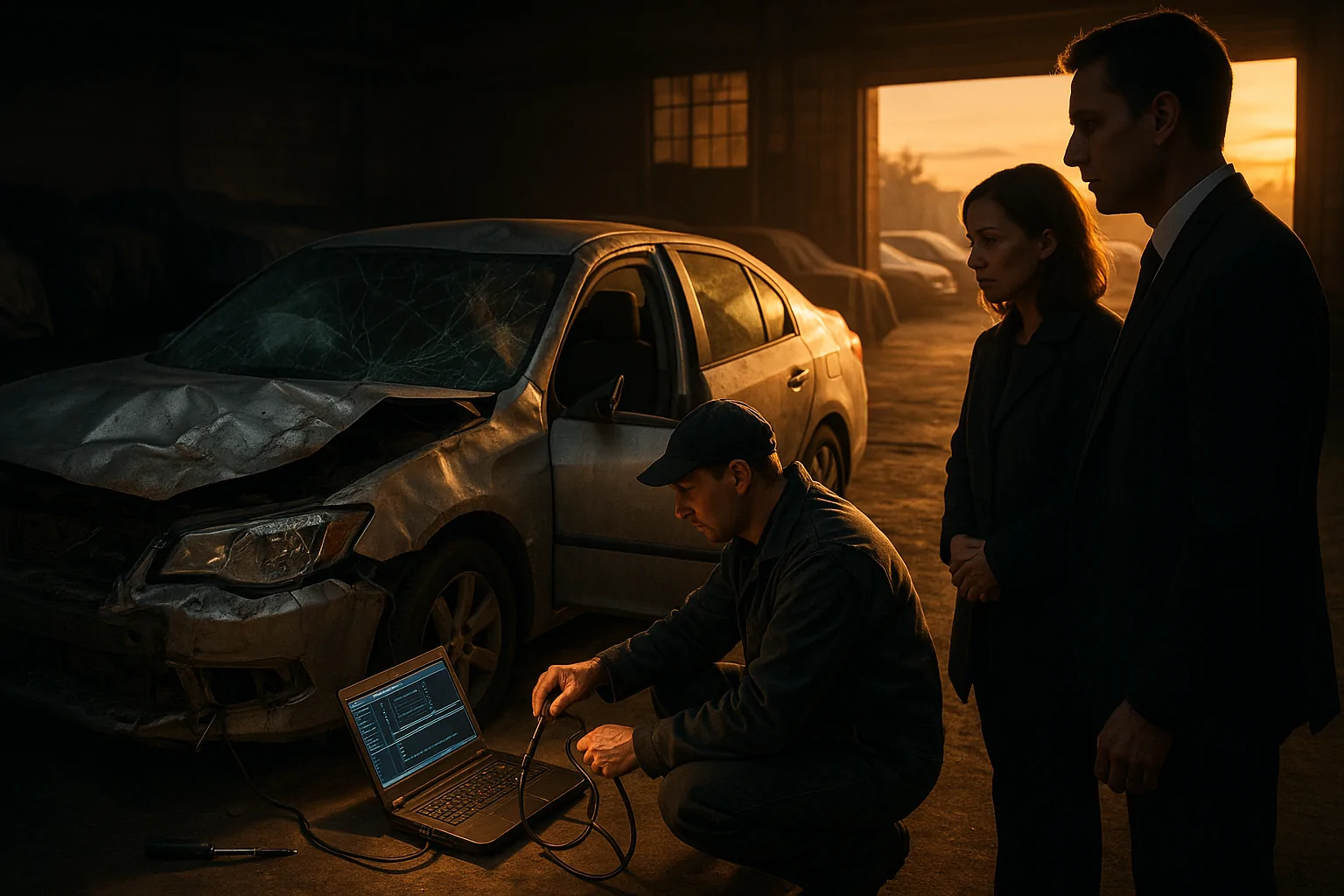
Define an Event Data Recorder (EDR) as a module, often embedded in the airbag control unit, that automatically records a brief, event-triggered snapshot of vehicle parameters (speed, braking, steering, airbag deployment timing, seatbelt status, etc.) around the moment of a collision. Many automakers place the EDR within or near the airbag control module beneath the console or front seats, and it is typically triggered by sudden deceleration or airbag deployment. For a practical overview of EDR purpose and location, consult this EDR recovery overview.
Clarify that an EDR is not a continuous video camera—most EDRs capture numeric sensor data for seconds only. They do not generally store audio, video, or GPS tracks. Acting quickly matters because some units can overwrite prior events if the vehicle is driven post-crash or if power is interrupted; see guidance on preservation urgency in this article urging drivers to act quickly to preserve black box data. For a broader technical and forensic context (including what EDRs are and what they are not), see this industry primer on car “black boxes” and five things to know.
Courts and investigators value EDRs for objective corroboration because the data is recorded by the same safety module that deploys airbags. In disputed-fault collisions, that objectivity can shift outcomes and support event data recorder crash claims by aligning sensor data with scene evidence. For the legal and practical advantages of EDRs, review this discussion of how vehicle black box data can strengthen a car accident case.
What data does an EDR record?
What EDRs log varies by make, model, and year; the National Highway Traffic Safety Administration (NHTSA) has published standards for EDR data elements (49 CFR Part 563), but implementation differs across vehicles. For an accessible summary of this variation and EDR benefits, see how EDR data strengthens car accident claims. Commonly recorded parameters include:
- Vehicle speed — instantaneous speed values recorded at short intervals before crash; essential for speed-related liability. See a practical list of typical points in this guide to using black box data in auto accidents.
- Longitudinal acceleration/deceleration — used to estimate braking force and impact severity; sometimes logged as “delta-V.” A deeper overview of collected values appears in this EDR data explainer on what EDRs collect.
- Brake application/ABS activation — shows when brakes were applied and whether anti-lock braking engaged, often crucial in rear-end or intersection cases.
- Throttle position/engine RPM — helps indicate driver input and potential accelerator issues or unintended acceleration claims.
- Steering wheel angle — assists in reconstructing steering actions leading up to the crash, especially in lane departure or loss-of-control events.
- Seatbelt status (buckled/unbuckled) — relevant to injury severity and comparative fault arguments; also influences airbag deployment logic.
- Airbag deployment time and event flags — time-stamped deployment helps anchor the crash timeline to milliseconds.
- Supplemental data where present (gear selection, stability control activation, traction control, and more) — increasingly available on newer models.
Important limitations to keep in mind:
- EDRs capture an event-triggered snapshot (often 5–20 seconds pre-/post-impact), not continuous recording. See this practical discussion of scope and variability in EDR use in accident claims.
- EDRs are not usually GPS or video; most record numeric sensor data only. For why unbiased, non-video data still matters, review this analysis of objective EDR evidence.
- Data can be lost if power is disconnected or overwritten by subsequent events or driving. Preservation urgency and overwriting risk are covered in guidance to act quickly after a crash.
When combined with skid marks, crash scene mapping, and vehicle inspections, this black box car accident evidence becomes a powerful anchor for event data recorder crash claims. For perspective on how EDRs fit alongside other evidence types, see cautions and best practices in “Beware the black box”.
How EDR evidence helps accident claims
EDR evidence can change the outcome of claims and litigation because it provides objective measurements of driver inputs and vehicle responses at the critical moments before and during impact. It shines in cases where stories conflict or where memories have faded. See this overview of practical uses for EDR data in auto accident reconstructions and this discussion of why EDR data often sways adjusters and juries.
Establishing speed at impact
Recorded speed values within the seconds before the crash allow comparisons with posted limits and safe speed arguments. When the number is high and braking late or absent, liability can swing dramatically.
Showing brake timing/use
Brake switch status and ABS activation help prove whether a driver attempted to avoid the collision, undermining claims of “no time to react” or supporting sudden emergency defenses.
Reconstructing chronology
Airbag deployment timing and high-resolution sensor logs create a millisecond timeline tying vehicle motion to the moment of impact and restraint activation.
Corroborating or disproving witness testimony
Objective logs can support a careful witness or expose an inaccurate recollection, particularly regarding speed, swerving, or late braking.
Injury causation and severity context
Deceleration values and impact severity (delta‑V) help medical experts explain injury mechanisms and link symptoms to crash forces, improving case clarity for adjusters and jurors. For more on how experts leverage technical data, see the role of crash scene science and reconstruction.
Multi-vehicle reconstructions
In chain-reaction or intersection crashes, combining EDRs from multiple vehicles enables synchronized timelines that pinpoint when each driver braked, turned, or accelerated.
Black box proof speeding accident
Consider a “black box proof speeding accident” example: an EDR readout shows the striking vehicle at 65 mph entering a 40 mph zone with no recorded pre‑impact braking. That numeric discrepancy, tied to time-stamped data, can remove “safe speed” defenses and sharply increase liability exposure and settlement value. For context on how records like these influence outcomes, see both this primer on how EDR data strengthens cases and this overview of practical EDR uses. Specialized labs, such as those described by forensic reconstruction services, routinely analyze these readings and defend their methodology.
To strengthen any EDR‑based argument, pair the download with other objective evidence. Useful companion items include the auto accident evidence collection checklist, expert reconstruction support, and where available, dashcam footage that visually confirms the EDR timeline.
How to preserve and retrieve crash data from vehicle
EDR data is perishable. It can be lost through repairs, battery disconnection, or overwriting if the car is driven after the collision. The most effective strategy is to secure the vehicle, give written preservation notice, and schedule an expert download as soon as feasible. Practical risks and urgency are highlighted in guidance from both a litigation perspective and salvage/repair contexts—see advice to act quickly to preserve black box data and common-sense preservation steps discussed by trial attorneys emphasizing chain of custody.
Immediate preservation steps
- Secure the vehicle. Do not allow repairs, salvage processing, battery disconnection, or airbag module replacement—these actions can erase or overwrite EDR data. See why this matters in this article urging immediate action to preserve black box data.
- Photograph VIN and module area. Take high-resolution photos of the VIN plate, possible module location under the seat/console, and overall vehicle damage; note mileage and condition. Location context for the module appears in this EDR overview and recovery guide.
- Notify parties. Contact your attorney and insurer immediately and request a written preservation letter to the vehicle owner, salvage yard, repair shop, and (as needed) the manufacturer, instructing that EDR and related electronic data be preserved. See practical preservation letter guidance in this chain-of-custody focused resource.
- Arrange secured storage/tow. If possible, tow the vehicle to secured storage designated by counsel to prevent unauthorized work while you schedule an expert download.
Who can retrieve the data?
- Certified forensic technician or independent EDR specialist. Preferred for impartiality, experience with multiple OEMs, and courtroom defensibility. Many independent labs also provide expert testimony; see examples of services in forensic accident reconstruction.
- Dealership or manufacturer service center. Sometimes able to extract, but may be slower and can raise discovery or access issues. If a dealer performs the download, document the chain of custody thoroughly—who accessed the vehicle, tools used, and outputs provided (including raw files and logs). Chain-of-custody pointers: preserving and proving integrity of EDR evidence.
Independent experts often produce a neutral report and can explain extraction methodology under oath. Manufacturer extractions may require authorization, subpoena, or consent and can be limited in scope or interpretation.
Methods and tools
- CDR (Crash Data Retrieval) tools via OBD-II port or a direct module (ACM) connection—tool support varies by OEM. Some extractions require removing the module for a bench download. See what a comprehensive download entails in this overview of black box data services.
- Onboard diagnostic ports and direct access. Depending on crash damage and configuration, technicians may use an OBD adapter or direct harness to ensure complete data acquisition.
- Chain-of-custody documentation. Record who handled the vehicle, dates/times, extraction device used, screenshots of raw logs, and expert sign-off. Robust documentation helps defeat tampering claims; see chain-of-custody emphasis in litigation guidance.
Timelines and risks
- Extraction window: Target extraction within days to a couple of weeks. Some systems store only 1–3 events, and new driving can overwrite crash data. Practical overwrite concerns and scheduling realities are discussed in this resource on black box preservation.
- Repair/salvage risk: Battery replacement, module swaps, or airbag control work can wipe data. Avoid any work orders until the download is complete. Again, see preservation urgency guidance to act quickly after a crash.
If you must move the vehicle or allow limited access (for storage or insurance inspection), note every transfer and ensure all parties understand the requirement to preserve and retrieve crash data from vehicle before any repairs proceed. For a step-by-step approach to building a broader evidence file around the EDR, consult guides to evidence collection in auto cases and the role of accident reconstruction experts.
Legal use — EDR data car crash lawsuit and vehicle recorder information in lawsuit
In many jurisdictions, EDR evidence is admissible if properly authenticated and the chain of custody is proven. Courts often accept vehicle recorder information in lawsuit proceedings when the proponent demonstrates reliable extraction methods and presents an expert to explain the data. See discussions of admissibility and value in this overview of how black box data strengthens car accident cases and this practical guide to using EDR data.
Admissibility basics
- Chain of custody. Document the vehicle from the scene through storage, extraction, and reporting. That includes VIN photos, module location images, storage logs, and expert signatures. Litigation strategy emphasizes integrity in this resource on preserving black box data.
- Authentication/foundation testimony. An expert should explain EDR operation, specific extraction steps, and why the data is reliable and relevant to the issues in the case.
- Expert interpretation. Raw EDR outputs are technical; expert reports translate timestamps, units, speed values, and sensor flags into a usable narrative the court can evaluate.
Common legal defenses/challenges
- Accuracy/calibration attacks. Defendants may question sensor accuracy or OEM software. Experts counter with manufacturer specifications, tool validation, and diagnostic logs. See practitioner cautions in “Beware the black box”.
- Overwriting/alteration claims. Robust chain-of-custody and digital logs (including file hashes where available) help rebut tampering allegations. See chain-of-custody emphasis in trial guidance.
- Scope/interpretation disputes. Parties may argue whether “vehicle speed” corresponds to wheel speed or GPS (most EDRs do not log GPS). Comparative physical evidence and scene analysis help resolve these disputes.
Practical steps for attorneys
- Send immediate preservation letters to the owner, manufacturer, salvage shop, and storage yard with VIN, request to preserve the EDR and modules, and instructions to suspend repairs.
- Coordinate an early joint inspection or agreed expert download to reduce later fights about access and integrity.
- Use subpoenas to obtain OEM download protocols or calibration records if necessary.
- Retain an EDR expert early; request a demonstrative exhibit (speed/time chart) and annotated raw printouts.
- Prepare exhibits: raw extraction logs, the expert’s methodology with margins of error, speed/time charts, VIN and module photographs, and a list of tools used during extraction.
Note: Admissibility rules and procedures differ by jurisdiction—consult local counsel or primary court rules. For a general review of litigation process steps that may surround an EDR data car crash lawsuit, see this overview of the auto accident litigation process.
Event data recorder crash claims — timeline, costs, and who pays
Costs vary by car type, crash severity, access to the module, and vendor availability, but useful general ranges include:
- Extraction cost: Approximately $500–$2,000, depending on whether the download can be completed through the OBD‑II port or requires module removal and bench work. For perspective on services and logistics, see forensic lab timelines and black box services.
- Expert analysis/report: Approximately $2,000–$5,000+ depending on complexity, number of vehicles, and whether reconstruction modeling is needed. Case value and negotiation leverage often justify these expenses; see how strong EDR evidence can advance claims in this discussion of why black box data strengthens cases.
Timelines
- Extraction: Often completed within days once scheduled; allow 1–2 weeks depending on expert availability and vehicle location.
- Analysis/report: Typically 1–4 weeks for a full expert report and demonstratives; additional time may be needed for deposition or trial exhibits.
- Court exhibits: Build in extra time for demonstrative graphics and pretrial disclosures.
Who pays and recovery strategies
- Attorneys commonly advance costs when EDR data is central, seeking reimbursement from settlement or judgment.
- Insurers may initially resist extraction, but preservation letters, discovery requests, and subpoenas usually prompt cooperation. When appropriate, propose a joint extraction to reduce disputes about integrity.
- Document all invoices and costs; pursue cost-shifting in discovery if the opposing party controlled the vehicle and delayed access to crucial evidence. Chain-of-custody and access issues are discussed in this resource on preserving black box data.
To understand where this evidence fits into total-case strategy, review the evidence required to prove negligence and the broader auto accident lawsuit timeline.
Limitations, privacy, and common myths
Limitations
- Not all cars have EDRs. Many models since the mid‑2000s include EDR functionality, but older vehicles may not. See general prevalence and location notes in this EDR overview.
- Short data window. Most EDRs store only 5–20 seconds of pre/post-crash data and 1–3 events total; overwriting is possible if the car is driven afterward or power is disrupted. Urgency is emphasized in this preservation guide.
- No built-in video in most EDRs. EDRs are distinct from telematics and connected services; they generally store sensor snapshots, not images or GPS tracks. See myth clarification in this primer on what a car “black box” records.
Privacy and ownership
Ownership and access rules vary by jurisdiction. Vehicle owner consent, preservation letters, or subpoenas are common paths to access, and laws differ—always consult counsel before attempting access. Practical legal guidance on access and preservation can be found in resources discussing EDR use in auto cases. When disputes arise about vehicle recorder information in lawsuit contexts, courts consider privacy, consent, and relevance alongside evidentiary standards. NHTSA maintains EDR resources and federal standards at NHTSA.gov.
Myths to debunk
- Myth: “EDR is a continuous camera.” Reality: EDRs generally record short, numeric sensor snapshots—no video. See clarification in this black box explainer.
- Myth: “EDR proves everything.” Reality: EDR is one piece of evidence. It must be corroborated with scene photos, physical evidence, witness statements, and medical documentation.
For complementary evidence planning, review the role of crash scene investigation science and evidence collection best practices.
Case studies / examples
Example 1 — Speeding / T‑bone (black box proof speeding accident)
EDR readout showed 70 mph with no pre‑impact braking while entering a signalized intersection; the driver claimed 45 mph. The mismatch shifted liability decisively and increased the settlement multiple times over initial offers. Why this happens: objective speed and brake flags collapse disputes about perception and reaction time. See case value dynamics in these resources on EDR applications and locations and how black box data strengthens a case.
Example 2 — Braking / seatbelt comparative fault
EDR indicated late braking (less than one second before impact) and an unbuckled occupant. The plaintiff’s damages were reduced under comparative fault, but the data still supported the victim’s timeline and helped allocate responsibility among multiple drivers. See how such objective elements affect evaluation in this overview of EDR’s role in settlement.
Example 3 — Before/after settlement impact
Without EDR data, a contested liability claim stalled for months. After extraction, a clear acceleration profile and late brake activation aligned with debris patterns, producing a full-value settlement shortly thereafter. Download logistics and reconstruction context are typical of those described by forensic reconstruction labs.
These examples also show how EDRs complement other proof. Consider pairing EDR downloads with a police report, dashcam footage, and targeted expert witness testimony to solidify your theory of the case.
Checklist — What to do after an accident to preserve black box car accident evidence
- Record the basics. Photograph the VIN, license plate, vehicle make/model, and odometer/mileage. Capture damage, interior airbags, and the area where the airbag module is located.
- Photograph the scene. Wide and close shots of the roadway, debris, skid marks, resting positions, and traffic control devices.
- Note the vehicle’s current location and where it will be towed; record the tow company and storage yard details.
- Do NOT authorize repairs, module replacement, battery disconnection, or salvage sale until a qualified expert downloads the EDR.
- Notify your attorney and insurer promptly and request a written preservation letter to the vehicle owner, storage yard, repair shop, and manufacturer directing them to preserve EDR data. Immediate action matters; see urgency in this guidance to act quickly after a crash.
- Arrange secure storage if possible and limit access to prevent accidental power cycling or repairs that could erase data.
- Retain a certified EDR forensic specialist within 1–2 weeks for extraction and reporting; consider a joint inspection with opposing experts when appropriate.
- Maintain chain of custody: Log every person who handles or transports the vehicle, plus dates/times and reason. Chain-of-custody guidance appears in this preservation resource from trial attorneys.
- Retain documentation. Keep invoices, communications, extraction reports, and all related photographs.
Sample preservation language (insert in letters/emails): “Preserve all electronic data, including Event Data Recorder (EDR) and crash data, from VIN [insert VIN] and any associated vehicle modules pending potential litigation. Do not alter, repair, reset, or otherwise modify modules or vehicle systems. Please confirm receipt and storage location in writing.”
Next steps / when to consult a lawyer or EDR expert
If you suspect EDR data could influence liability or damages, act promptly to protect evidence. Send a preservation request, secure the vehicle, and coordinate with a certified EDR specialist. Laboratories offering black box services, like those described in this overview of forensic accident reconstruction, can assist with downloads and expert analysis. For legal context on using EDRs in claims and litigation, review these insights on how vehicle black box data strengthens cases and consider how EDR fits into broader evidence strategy with auto accident litigation planning and reconstruction expert support.
Conclusion
Black box car accident evidence can be the difference-maker when fault is disputed. But EDR data is perishable, technical, and persuasive only when collected, documented, and explained correctly. By securing the vehicle, sending preservation letters quickly, and working with qualified experts, you maximize the value of this objective evidence and protect your claim. If you have questions about EDR data, timelines, or admissibility, consider pairing the download with a disciplined evidence plan and a litigation strategy that anticipates calibration, interpretation, and chain-of-custody challenges.
Need help now? Get a free and instant case evaluation by Visionary Law Group. See if your case qualifies within 30-seconds at https://eval.visionarylawgroup.com/auto-accident.
FAQ
How long does EDR data last?
Most EDRs capture only a short snapshot—typically 5–20 seconds of pre/post-crash data—and may store just 1–3 events. Data can be overwritten by subsequent driving or lost if power is disconnected or modules are replaced. See EDR basics in this EDR overview and preservation urgency in this guide to act quickly after a crash.
Can EDR data be altered?
When properly extracted and documented, alteration is unlikely, and a solid chain of custody plus raw logs can demonstrate integrity. Interpretation can still be debated, so an expert report helps explain methods and reliability. See practical guidance on EDR use and integrity in these resources on using black box data and preserving EDR evidence.
Do all cars have EDRs?
Many vehicles built since the mid‑2000s include EDR capability, but not all. Implementation varies by manufacturer and model year. For a general overview of benefits and prevalence, see this primer on how EDR data strengthens cases and consult authoritative EDR resources at NHTSA.gov.
Can I obtain EDR data without owner consent?
Access usually requires vehicle owner consent, a preservation letter, or a subpoena/court order. Rules differ by jurisdiction—consult an attorney about your state’s requirements and best approach. See practical access and chain-of-custody issues discussed in this guide to preserving black box data.
Will EDR data always decide my case?
No. EDR is powerful but only part of the puzzle. The strongest cases pair EDR data with scene photos, physical evidence, medical records, witness statements, and expert analysis. For broader context, see evidence planning guides on proving negligence with key evidence and the role of reconstruction experts.