Table of Contents
Estimated reading time: 12 minutes
Key Takeaways
- A crash site debris caused accident is a secondary collision triggered by wreckage, spilled cargo, or a disabled vehicle left after an initial crash.
- Multiple parties can share fault—original drivers, trucking companies, tow/cleanup crews, property owners, manufacturers, and government entities.
- Liability turns on negligence elements: duty, breach, causation (including foreseeability), and damages—proven through photos, time-stamped records, and expert analysis.
- California government claims have strict deadlines: present an administrative claim within six months before any lawsuit against a public entity.
- Immediate evidence preservation—scene photos, witness info, dashcam, debris fragments, 911 logs, and maintenance records—dramatically strengthens your claim.
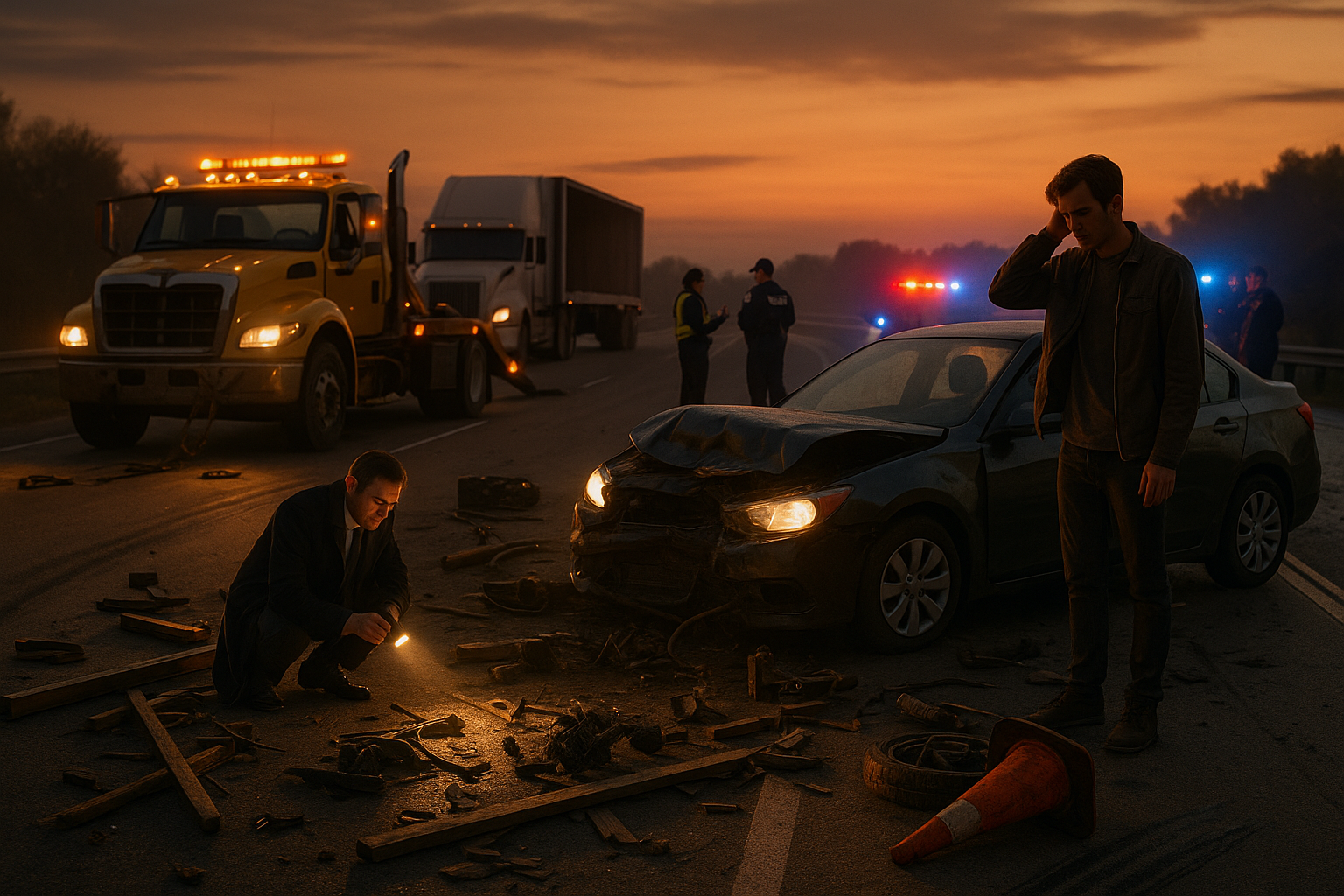
A crash site debris caused accident happens when wreckage, spilled cargo, or a disabled vehicle left on the roadway creates a new hazard that causes a secondary collision. This guide explains why secondary crash after accident scene events occur, who may be legally responsible, and how victims preserve evidence and pursue claims.
In plain terms, a crash site debris caused accident is a secondary collision caused by hazardous material or an obstruction left after an earlier wreck. Typical causes include debris from damaged vehicles, spilled cargo, disabled vehicles blocking lanes, fuel or oil slicks, and inadequate warning devices—conditions that frequently catch drivers off guard and lead to collisions or loss of control. These scenarios and their risks are well-documented in practical guides on road-debris crashes.
This article shows who may be liable (drivers, trucking companies, tow/cleanup contractors, property owners, product manufacturers, and municipalities), what you must prove (duty, breach, causation, damages), California’s special filing rules for public entities, and a step-by-step evidence checklist. You’ll get a roadmap through the key sections: definition, liable parties, legal theory, evidence checklist, California government-claim process, hiring a lawyer, and a practical timeline checklist. As several resources note, identifying the responsible party and proving duty/breach/causation are essential steps to recovery in debris-related cases (maintenance and liability insights; who can be responsible).
What is a “crash site debris caused accident”?
Define a crash site debris caused accident as: a secondary collision caused by hazardous material left on the roadway after an initial crash — debris that originates at the accident scene (vehicle parts, cargo, fuel, disabled vehicles, tow/recovery equipment) rather than unrelated litter.
Common, real-world examples include:
- Cargo spillage: Unsecured commercial loads can scatter across lanes, reduce traction, and obscure sightlines. Federal and state load securement rules place specific duties on carriers, and violations strengthen liability claims (see analyses on cargo-related debris and liability and responsibility for road debris).
- Vehicle parts/components: Bumpers, tire treads, fenders, mirrors, and broken glass can puncture tires, cause loss of control, or prompt sudden swerves (road debris risk overview).
- Fuel/oil spills: Slick surfaces from gasoline, diesel, or oil increase stopping distance and spin-out risks and can also introduce fire hazards (how fluid leaks create danger).
- Detached trailers/equipment and disabled vehicles left in lanes: Blocked travel lanes without proper warning devices or traffic control create predictable secondary collisions (duty to remove hazards and warn).
- Debris from recovery operations: Tow chains, tools, and equipment left behind or moved unsafely during cleanup can cause fresh hazards (tow/cleanup responsibilities).
Secondary crashes occur in two primary ways. A driver may strike the debris, lose control, and collide with another vehicle or barrier. Or the driver may swerve to avoid the debris and crash into another vehicle or object. These reactions are foreseeable when debris remains in active lanes or warnings are inadequate—an important point for liability (why debris causes collisions; foreseeability and responsibility). Understanding foreseeability helps explain why a secondary crash after accident scene hazards often leads to successful claims.
Typical parties who can be liable
Secondary debris claims often involve multiple defendants. Fault can be shared among the person or entity that created the hazard and those who failed to remove, mark, or warn about it in time.
Original at-fault driver / vehicle owner
Why liable: The original driver may have created the wreck, left a disabled vehicle in a lane, failed to secure a load, or failed to deploy hazard lights/triangles. Owners who allowed unsafe loading or neglected maintenance can share responsibility. Police reports, photos showing a vehicle blocking the lane, witness statements, and tow records help connect the driver to the hazard (debris hazards and driver duties; who is at fault when debris causes an accident).
Trucking companies and cargo owners
Why liable: Carriers must secure loads, maintain equipment, and supervise drivers. Shippers and loaders can share fault for improper loading. Key evidence includes bills of lading, driver logs, inspection/maintenance files, loading dock records, and dispatcher communications. Violations of cargo securement standards can be powerful proof (trucking liability for debris; how companies and shippers can be responsible).
Tow / cleanup contractors (private recovery companies)
Why liable: These crews owe a duty to remove debris safely and to provide adequate traffic control. A clean up failure caused car accident may occur if debris is left scattered or if cones/flares/triangles aren’t deployed properly. Useful evidence includes tow/cleanup invoices, photos showing the presence or absence of cones, contract terms, and witness statements, along with industry guidance on safe recovery operations (cleanup obligations and liability; who can be liable for debris).
Property owners / contractors
Why liable: If debris originates from private property (e.g., a nearby jobsite) or a private contractor’s work, those parties can be liable for failing to contain materials or prevent migration onto the roadway. Evidence: site inspection records, haul manifests, contractor agreements, and photos tying the debris to the property or project (property- and contractor-sourced debris).
Government entities / municipalities / DOT
Why liable: Public agencies must maintain reasonably safe roadways, respond to known hazards, and deploy traffic control or close lanes as needed. A road not cleared after wreck claim CA or hazard left at crash site legal claim may arise if the entity had actual or constructive notice of roadway debris but failed to act within a reasonable time. Evidence includes maintenance logs, 911/dispatch records, work orders, and response-time documentation (public duties and debris risks; California-focused duty and claims process).
Manufacturers/repair shops (product liability)
Why liable: Defective parts (e.g., tires, axles, hitches) or improper repairs can create debris and secondary-crash risks. Evidence can include part numbers, recall notices, repair invoices, and expert materials testing linking the defect to the hazard (manufacturer/repair-shop responsibility).
Because these claims can involve several defendants, courts and insurers may divide fault among them. This allocation can affect your total recovery and how much each party ultimately pays.
Legal theory: how liability is established
Debris claims are usually negligence cases. The elements are: duty, breach, causation, and damages. Each must be proven with specific evidence.
Duty of care
Duty is the legal obligation to exercise reasonable care under the circumstances. Drivers must secure their loads and warn others; contractors must remove debris and use appropriate traffic control; municipalities must keep roads reasonably safe and respond to hazards; and trucking companies must train drivers and maintain vehicles (duty in debris cases).
Breach
Breach is a failure to act as a reasonably prudent person or organization would. Examples include failing to remove debris, neglecting to deploy warning devices, or not securing a load as required by industry standards. Similar breaches have been recognized across debris scenarios, including negligent cleanup and delayed responses (cleanup and notice failures).
Causation
There are two parts. “But-for” causation asks: but for the defendant’s breach, would the crash have occurred? Proximate cause asks whether the crash was a foreseeable result of the breach. Proving causation often requires a clear chain of evidence—time-stamped photos and video, witness statements linking the hazard to the incident, 911 logs, and expert reconstruction showing debris location relative to vehicle trajectories (causation in debris cases).
Foreseeability & intervening cause defenses
Defendants may argue that a driver’s sudden maneuver was an unforeseeable, independent act that breaks the causal chain. Courts often reject these defenses when the hazard is substantial and a sudden reaction (swerving or braking) is predictable in traffic. In other words, a secondary crash after accident scene debris is frequently foreseeable (foreseeability of secondary reactions).
Damages
Recoverable damages include medical expenses, lost wages and earning capacity, pain and suffering, property damage, and—in egregious cases—punitive damages for gross negligence. Proper documentation and expert support are key to proving each category (damages categories in debris claims).
Sample causation sentence for a demand letter: “But for Defendant’s failure to remove the spilled cargo and to deploy warning devices within 10 minutes as required by industry standards, Plaintiff would not have encountered the hazard that forced a sudden evasive maneuver and caused the collision.”
If your case involves a public agency, your claim strategy may also implicate issues like a hazard left at crash site legal claim, potential immunities, and notice rules—topics handled in more detail below.
Special issues in secondary-crash claims
Secondary-crash claims create special proof challenges and defense arguments centered on who created the hazard, who caused the collision, and whether the reaction was foreseeable.
Establishing who created the hazard vs. who caused the collision
Tracing debris to its origin matters. Methods include matching serial numbers or manufacturer markings, comparing cargo manifests to what’s on the roadway, and comparing vehicle damage patterns with debris shapes or materials. These steps help identify the original source—and thus the responsible party (tracing debris origin; see also context on road-debris liability in debris-related responsibility).
Comparative negligence / fault allocation
California uses comparative negligence, so a plaintiff’s recovery is reduced by their percentage of fault. If you were speeding or following too closely, a defense may argue partial fault. Strong evidence showing a sudden, obscured, or unavoidable hazard can minimize your share of fault (how fault is allocated). For a deeper dive on California’s framework, see our guide to comparative negligence.
Intervening acts & defendant defenses
Common defenses include blaming a third party’s sudden lane change or a mechanical failure unrelated to debris. Counter with expert reconstruction, a tight timeline (911 logs, CAD data), and video evidence (dashcam or traffic cameras) showing the sequence. This evidence helps keep the focus on the original hazard’s role (countering intervening-cause arguments).
Unique fact patterns
- Disabled car left in lane: Likely defendants: the original driver and possibly a tow/cleanup contractor. Best evidence: photos of the obstructing vehicle, absence of warning devices, and 911 dispatch times (why obstruction hazards matter).
- Cargo spill not cleaned for an extended period: Likely defendants: the trucking company and, if notified and slow to respond, a public entity. Best evidence: 911 logs, maintenance records, photos showing the debris over time (notice and delayed cleanup).
- Emergency scene with inadequate warnings: Possible public-entity liability when traffic-control measures fall short. Best evidence: scene photos, policy manuals, training records, and response-time logs (traffic-control obligations).
Practical evidence & proof checklist
Immediate, specific actions preserve evidence that proves duty, breach, and causation.
- Call 911 and request police and medical help: This creates an official record and captures early observations that bolster causation and notice.
- Photograph/video debris and the entire scene: Capture multiple angles, lane markers, and distances. Include a known-size object or measuring tape to show scale and location relative to lanes and vehicles (scene documentation tips).
- Photograph vehicle positions and damage: Document crush points, tire damage from debris, and resting positions to help reconstruction.
- Record witness names and numbers: If they consent, take short recorded statements about what they saw and when.
- Preserve dashcam and phone video: Copy files to the cloud and note exact timestamps to avoid overwriting (our guide on using dashcam footage can help).
- Save debris fragments and receipts: Place fragments in labeled bags and keep tow/storage invoices; these help with materials testing and establishing chain of custody.
- Do not repair your vehicle yet: Obtain a written estimate first and keep all invoices to prove property damage and timing.
- Obtain official records: Promptly obtain the police report and request 911 dispatch logs for timing and responses.
- Request municipal/Caltrans maintenance logs and tow/cleanup invoices: These tie response times to potential breach of duty (public-entity response records).
- Preserve surveillance/traffic camera footage: Send preservation letters quickly; video can reveal debris origin and timing.
- Retain experts: An accident reconstructionist can map debris paths; a materials expert can link debris to its source (why experts matter). Consider capturing EDR data too (see our resource on vehicle black box evidence).
- Keep medical and wage records: Save treatment plans, bills, pay stubs, and employer letters to prove your damages.
Filing claims: private defendants vs. public entities in California
Claims against private parties follow standard personal-injury procedures. Claims against public entities require an additional administrative process before any lawsuit.
Private parties: typical procedure
- Report to insurers: Open a claim and obtain a claim number.
- Preserve evidence: Send preservation letters to likely custodians (tow companies, trucking firms) to prevent spoliation.
- Demand letter checklist: Summarize facts, explain liability, present causation, and attach damages documentation with a reasonable deadline.
- Statute of limitations: In California, personal-injury claims are typically two years from the date of injury (exceptions may apply; confirm specifics). For a deeper overview, see our guide to California filing deadlines (general claims process context). These steps lay the foundation for any potential lawsuit for post-accident hazard.
Public entities in California — Government Claims Act
If your claim involves Caltrans, a city, county, or other public agency, you must follow the California Government Claims Act before suing.
You must present a written administrative claim to the appropriate public entity within six months of the incident (California’s six-month claim rule).
Your administrative claim should include: (1) your name, address, and phone number; (2) the date and location; (3) a description of the injury/property damage and an approximate dollar amount; and (4) a brief statement of facts showing how the entity’s negligence caused your harm (required contents).
Delivery and proof: Use certified mail with return receipt or hand-deliver to the claims administrator, and keep copies.
Agency response timeline: The agency has 45 days to accept, reject, or offer settlement. If rejected (or no response), you generally must file suit within the applicable statutory window—often within one year after claim presentation, subject to the details of the rejection and overall limitation period (timing and suit deadlines).
Immunity and exceptions: Government entities may assert immunity, but dangerous conditions of public property claims can proceed if the agency had actual or constructive notice and failed to correct or warn in time (dangerous-condition claims and notice). For related scenarios, see our overview of pursuing a government claim in California.
Practical tips: Draft a concise narrative, attach medical bills and photos, list all damages, and consider counsel to avoid procedural pitfalls in any road not cleared after wreck claim CA or hazard left at crash site legal claim.
When to hire a lawyer & what a lawyer will do
Consult an attorney immediately when injuries are significant, liability is disputed, multiple defendants are involved, or a government entity may be responsible.
- Preservation letters: Send to tow companies, municipalities, Caltrans, and private defendants to stop evidence destruction (why preservation is urgent).
- Records and footage: Obtain police reports, 911 logs, maintenance records, DOT logs, and traffic camera video (what evidence matters).
- Experts: Retain an accident reconstructionist, materials engineer, and traffic-control expert to solidify breach and causation (expert use in debris cases).
- Government claims: Prepare and file the administrative claim and docket all deadlines for California entities (Gov’t Claims Act steps).
- Damages and negotiation: Calculate losses with medical and economic experts; draft a demand and negotiate against insurer defenses, including comparative fault.
- Litigation: File the complaint, manage discovery, depose witnesses, and present expert testimony at trial, if needed.
Most personal injury attorneys work on contingency—no upfront fee, with payment from the recovery. Always sign a written fee agreement and ask how litigation costs are handled. Early legal help is especially important in a clean up failure caused car accident and any lawsuit for post-accident hazard.
Step-by-step checklist for victims
At the scene
- Call 911; get medical evaluation even if symptoms are mild.
- Photograph lane markers, the debris’ location relative to the road edge, warning devices (or lack thereof), lighting conditions, and vehicle positions.
- Collect witness names and contact details; if willing, record short statements on what they saw.
Within 24–72 hours
- Request the police report using your case/report number; ask how to get 911/CAD logs. Save the report number and officer’s name (how to obtain the police report).
- Seek a full medical assessment; save all bills and receipts.
- Preserve dashcam footage; back up to the cloud with exact timestamps.
Within 2–4 weeks
- Consult a personal injury attorney; request preservation letters.
- Collect tow/cleanup invoices; request city/Caltrans maintenance logs (sample wording: “Please provide all work orders, hazard reports, and response-time records for [location/date/time], including any lane-closure or signage deployment records.”).
- If a public entity may be at fault, prepare the six-month administrative claim. Include required contents: your contact info; date/location; injury/property loss and approximate amount; brief facts explaining the entity’s negligence (Gov’t Claims Act requirements).
Within 2–6 months
- Continue treatment; obtain a treating provider’s summary or MMI note.
- Submit a comprehensive demand package to all responsible insurers and begin negotiations.
- If a public entity is involved, track the 45-day response and suit-filing deadline closely.
Before the statute of limitations expires
- If settlement fails, file suit before the deadline (typically two years in California; confirm your dates and any shorter public-entity suits windows). To understand deadlines more fully, review our guide on California statutes.
Real-world examples and hypotheticals
Example 1: Unsecured trucking load causes secondary crash
Scenario: After a collision, a flatbed’s remaining load shifts. Several beams fall into two lanes. The driver calls dispatch but doesn’t deploy warning triangles. Thirty minutes later, a motorist swerves to avoid the debris and hits another vehicle.
Liability analysis: The trucking company and driver likely share fault for inadequate securement and traffic control. Shippers may share liability if loading was negligent. Evidence includes bills of lading, driver logs, maintenance and inspection records, and dispatch notes (unsecured loads and fault; company and shipper duties).
Likely damages: Vary widely; for moderate injuries, settlements could range meaningfully based on medical costs, lost income, and pain/suffering. Every case is unique.
What to do: Preserve photos, collect witness statements, and request traffic-cam footage. Retain an expert to map debris scatter and braking distances.
Example 2: Municipality fails to mark/clear disabled vehicles at night
Scenario: Two cars collide on a state highway and remain in a live lane at night. The agency response is delayed and inadequate warnings are posted. A third car, unable to see the obstruction in time, strikes the disabled vehicles.
Liability analysis: Potential public-entity liability for failing to deploy adequate traffic control. The original drivers may also share fault. A road not cleared after wreck claim CA requires careful notice and timing under the Government Claims Act (California public-entity liability and deadlines).
Best evidence: 911/dispatch logs showing timing, maintenance/work orders, and photos of the scene without sufficient warnings.
What to do: File a government claim within six months, request all response records, and consider an expert in work-zone traffic control.
Example 3: Tow company creates hazard during cleanup
Scenario: A tow crew removes a vehicle but leaves chains and tools scattered on the shoulder with only one cone. A motorist steers onto the shoulder to avoid road debris and strikes the tow equipment.
Liability analysis: The tow contractor likely breached industry traffic-control standards. This is a textbook clean up failure caused car accident with foreseeable harm (cleanup duties and negligence).
Best evidence: Photos showing inadequate cones, tow invoices with timing, and witness statements describing the crew’s actions.
What to do: Seek tow-company policies, crew training records, and any jurisdictional work-zone standards that apply. Consider referencing our construction-zone safety resource on work-zone equipment crashes.
Example 4: Defective part leads to debris and secondary crash
Scenario: A tire blowout caused by a defect scatters tire tread and rim fragments across lanes, causing a driver to swerve into oncoming traffic.
Liability analysis: The manufacturer or a repair shop may be liable under product liability or negligence. Evidence: part numbers, recall notices, repair invoices, and expert testing (product/repair liability for debris).
What to do: Preserve the failed parts, request recall history, hire materials experts, and evaluate a lawsuit for post-accident hazard based on the defect’s role.
Conclusion
A crash site debris caused accident often involves several responsible parties—original drivers, trucking companies, tow/cleanup contractors, property owners, manufacturers, and sometimes municipalities. Success turns on timely evidence preservation, a clear causation chain, and a careful negligence analysis. When public entities are involved, California’s Government Claims Act imposes strict deadlines, beginning with a six-month administrative claim (California procedures and deadlines; background on debris hazards from road-debris resources).
If you’re dealing with a debris-related secondary collision, act fast: preserve photos, video, and fragments; request police/911 logs; and consider early legal help to identify every liable party and meet time-sensitive claim requirements.
This article is for informational purposes only and does not constitute legal advice. Laws vary by jurisdiction and facts vary by case. For advice about a specific crash site debris caused accident or a hazard left at crash site legal claim in California, consult a licensed personal injury attorney in your area. See California Government Claims Act guidance for local deadlines.
Need help now? Get a free and instant case evaluation by Visionary Law Group. See if your case qualifies within 30-seconds at https://eval.visionarylawgroup.com/auto-accident.
FAQ
Can I sue the city if the road wasn’t cleared?
Yes—if you follow California’s Government Claims Act. You must present a written claim within six months and prove the entity had notice or should have known about the danger. Dangerous-condition exceptions can apply to a road not cleared after wreck claim CA or a hazard left at crash site legal claim (public-entity claims and deadlines).
What if an unsecured load caused the debris?
The driver and trucking company can be liable for improper securement and training failures. Shippers/loaders may also share fault. Bills of lading, driver logs, and inspection records are key (who is at fault for debris; responsibility for road debris).
How soon must I act?
Immediately preserve evidence. For government entities in California, file an administrative claim within six months. Private injury suits are typically two years from injury, but confirm your deadline. Early action strengthens your crash site debris caused accident claim (six-month rule; timelines overview).
How will fault be split if I swerved into debris?
California applies comparative negligence. Your recovery may be reduced by your share of fault, but sudden, obscured hazards often reduce plaintiff responsibility if well-documented (photos, video, experts). Fault allocation depends on facts (comparative-fault analysis).
Who pays for my vehicle damage if debris came from a truck?
If liability is established, the trucking company’s insurer typically pays. If not, your collision or uninsured motorist coverage may apply. Consult your policy and explore a lawsuit for post-accident hazard if necessary (trucking liability and insurance).