Table of Contents
Estimated reading time: 18–22 minutes
Key Takeaways
- Workers comp home modification coverage can pay for “reasonable and necessary” home accessibility changes that address medical needs and functional limits after a work injury.
- Common approvals include wheelchair ramps, roll-in showers, doorway widening, stair lifts, safety features, and kitchen access—each supported by medical prescriptions and an OT home assessment.
- In California, treating physician recommendations carry significant weight, and utilization review (UR) and IMR timelines matter—missed deadlines can affect the outcome.
- You can strengthen your request with precise medical documentation, itemized contractor bids, detailed photos, and an organized submission packet; keep follow-up logs and deadlines.
- If denied, request a written reason, submit a physician rebuttal with objective evidence, consider UR reconsideration/IMR, and file with the WCAB when needed.
Introduction
Workers comp home modification coverage can pay for essential accessibility changes — like ramps and bathroom remodels — that you need after a serious work-related injury. This guide explains which home accessibility changes are typically covered, step-by-step how to get them approved, what to expect in California, and what to do if your insurer denies your request.
If you are an injured worker or a caregiver, you’re not alone in trying to make a home livable and safe after a life-changing injury. Many people qualify for coverage when modifications are clearly connected to medical treatment, safety, and daily functioning. As a starting point, the process is about proving medical necessity and cost reasonableness, just as outlined in the widely cited overview of home modification coverage for injured workers from JusticeForYou’s explanation of home modifications under workers’ comp. We’ll also include California-specific notes throughout (watch for “work comp housing changes California” tips and timeline alerts).
What “workers comp home modification coverage” means
Define “workers comp home modification coverage” as financial assistance from a workers’ compensation insurer to pay for “reasonable and necessary” changes to a claimant’s home that are required for medical treatment, recovery, safety, or daily functioning after a work-related injury. In practice, approval typically hinges on two pillars: medical necessity and cost-effectiveness.
Reasonable and necessary means the modification directly addresses a functional limitation caused by the injury. For example, replacing steps at the entry with a safe wheelchair ramp to prevent falls and enable access is reasonable and necessary; installing upscale stone veneer for aesthetics without improving safety or function is not. Similarly, converting a bathtub into a curbless roll-in shower with grab bars to prevent slips and to allow seated bathing is necessary; adding luxury heated floors purely for comfort, when not medically indicated, likely is not.
The primary objectives are safety (fall prevention and hazard reduction), independence (performing basic tasks without undue assistance), activities of daily living (ADLs, like toileting, bathing, and meal preparation), and support of return-to-work or ongoing therapy (safe entry/exit for medical visits and treatment adherence). A concise overview of typical benefits and what counts as a covered modification can be found in JusticeForYou’s summary of home accessibility modifications under workers’ comp.
Types of home modifications commonly covered
Approvals are customized to your injury, mobility, and daily-function goals. Below are frequent categories, with practical details on insurer expectations.
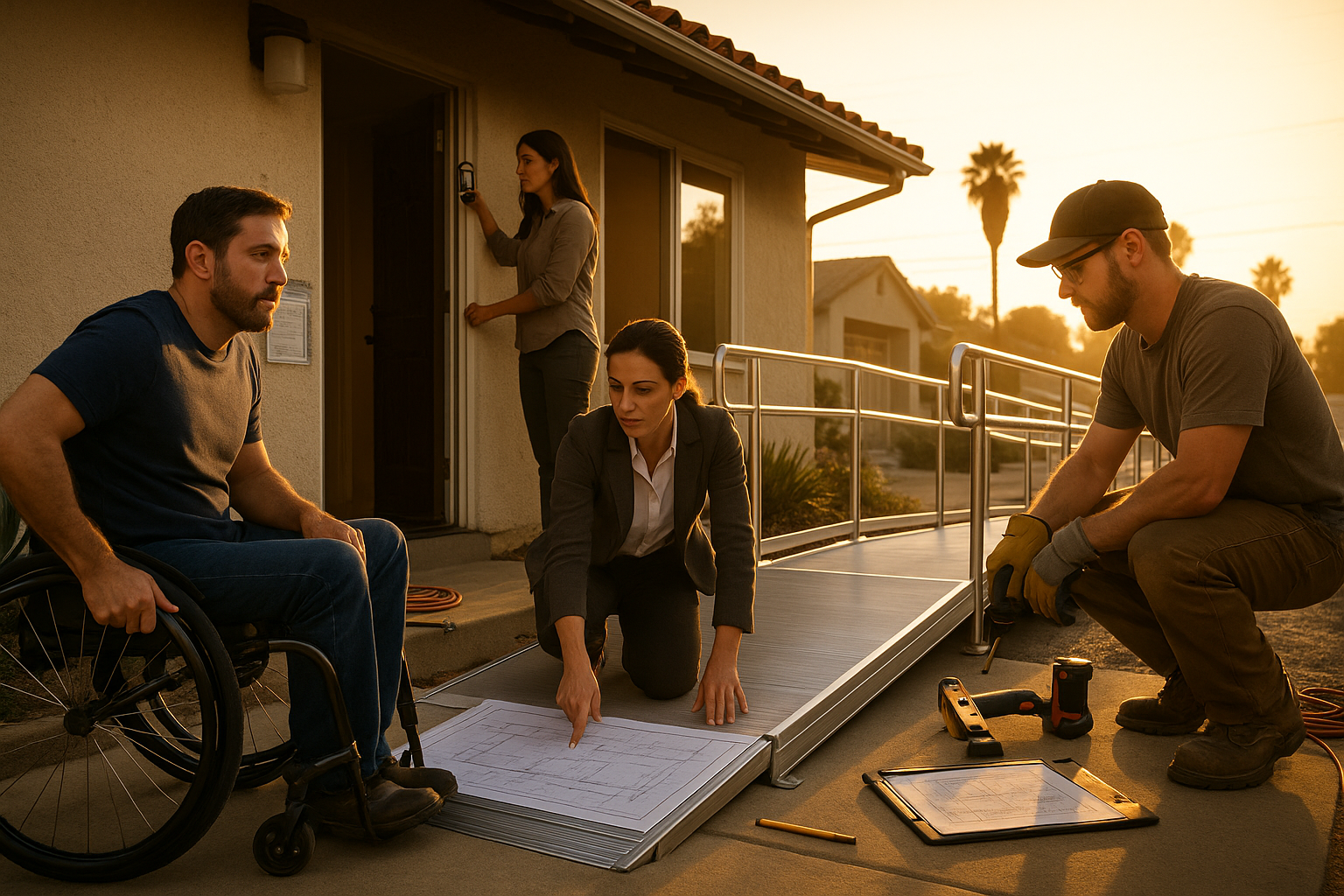
Wheelchair ramps and entrance modifications
Ramps can be modular aluminum (fast to install, adjustable, often rentable), pressure-treated wood (cost-effective, needs maintenance), or concrete (durable, higher upfront cost). Design matters: the ADA guideline of a 1:12 slope—meaning 1 inch of rise for every 12 inches of ramp length—is a helpful safety target, along with continuous handrails, non-slip surfaces, landings at doorways, and threshold transitions that are wheelchair-capable.
Insurers examine whether a temporary option (e.g., rental aluminum or a portable ramp) can safely meet the need at a lower cost, especially during recovery periods with uncertain long-term mobility. When long-term wheelchair use is likely, a permanent ramp may be more cost-effective. For a broader context on ramp and entry solutions in workers’ comp, see Enlyte’s discussion of home modification solutions in workers’ compensation. In scenarios involving a ramp-related incident, references to wheelchair ramp injury compensation should be tied to documented risk and necessity.
Bathroom remodels after work injury
A “bathroom remodel after work injury” typically means removing barriers and adding safety features: roll-in or curbless showers (no step), fold-down or built-in seating, properly placed grab bars, raised or ADA-height toilets, non-slip flooring, lowered or knee-clearance vanities, and clear maneuvering space (many OTs reference a 30″x48″ approach area for fixtures and shower clearances). These details help prevent falls and enable independent toileting and bathing—critical ADLs that reduce caregiver burden and improve dignity.
Cost drivers include plumbing reroutes (e.g., relocating drains for a curbless shower), structural changes (subfloor work for proper slope), demolition of existing tile, and, when medically indicated, electrical work (e.g., lighting for low-vision safety). Insurers look for explicit medical ties (“patient cannot step over a tub; curbless shower prevents falls during transfers”). For recognized examples and justification patterns, review Enlyte’s examples of bathroom modifications alongside JusticeForYou’s guide to covered home modifications.
Doorway widening and threshold removal
Doorways commonly need widening to a minimum 32″ clear width for wheelchair or walker passage. Non-structural adjustments (offset hinges) can sometimes gain an extra inch or so; structural widening (moving studs and re-trimming) is more invasive and expensive but often necessary. Thresholds should be beveled or removed for rolling access. Costs vary by wall type, wiring/plumbing in the wall, and finish work; insurers expect itemized bids explaining why each doorway needs widening and measuring before/after widths to support workers comp home modification coverage.
Stair lifts and residential elevators
Straight-run stair lifts are typically faster to source and install and cost less than curved lifts (which require custom rails). Lifts can be a fraction of the cost and timeline of a residential elevator. Elevators, while sometimes necessary, require substantial space, structural support, and local permitting; lead times can be significant. Requests must justify why a lift is insufficient or unsafe. California approvals for large-ticket items may consider cost limits in the overall benefit context for work comp housing changes California. For more on device types and case-fit, see Enlyte’s home modification overview.
Handrails, grab bars, safety features; kitchen accessibility; accessible parking/pathways
Insurers often approve smaller safety items quickly—grab bars at the shower and toilet, handrails on steps, additional lighting, non-slip finishes, and lever-style door handles/faucets. Kitchen accessibility may involve lowered counters, pull-out shelves, side-opening ovens, seated prep space, and clear knee clearance at sinks. Exterior access improvements—widened pathways, leveled pavers, and accessible parking pads—help ensure safe ingress/egress. If your original injury arose from an accessibility renovation work injury, tie recommendations to documented safety deficits and medical limits. Many of these smaller changes are straightforward workers comp home modification coverage when backed by precise OT measurements and the treating doctor’s prescription.
Temporary vs permanent modifications
Insurers generally approve the least costly solution that still meets medical needs. If your condition is expected to improve, temporary solutions (portable ramps, removable threshold wedges, suction or removable grab bars) may be authorized first; when long-term impairment is established, permanent structural changes are more likely. Your OT’s assessment and treating physician’s prognosis guide which route aligns with medical necessity and cost-effectiveness.
Who qualifies and what medical evidence is needed
Eligibility is primarily medical. You must have a work-related injury with an open claim or an active permanent disability pension. Catastrophic injuries—such as spinal cord injuries, amputations, severe traumatic brain injury, and significant neurological loss—often meet the threshold because they create major functional barriers at home. If your claim is closed but your condition has worsened, you may need to file to reopen the claim with objective medical evidence. These fundamentals are reinforced by the JusticeForYou discussion of catastrophic injuries and eligibility.
Documentation is the linchpin:
- Treating physician’s written recommendation or prescription specifying the exact modification(s), the functional limitation addressed by each item, and the anticipated duration (temporary vs permanent).
- Occupational therapy (OT) home assessment or Functional Capacity Evaluation (FCE) describing measured barriers (door widths, turning radii, thresholds), activity limits, and recommended solutions with specs (e.g., ramp slope, grab bar placement). If you were hurt during an accessibility renovation work injury, note causation and how the modification mitigates ongoing risks.
- Clinical notes and objective findings (imaging, neurologic exams, post-op notes) supporting the limitations.
- Photos and a simple floor plan identifying pre-existing barriers and the proposed changes.
- Itemized contractor bids and specifications (see hiring tips below).
In California, treating physician primacy is real—carriers must seriously consider your treating doctor’s recommendations. For official references and forms, consult the California Division of Workers’ Compensation (DWC). If your claim is still being established, read how to complete and submit the DWC-1: DWC-1 form guidance and download, and see an overview of California filing steps and timelines.
Step-by-step process to obtain coverage
Follow these steps in order and keep meticulous documentation.
Step 1 — Notify your claims adjuster and treating physician
Tell both that you are seeking workers comp home modification coverage and request prior authorization. Attach your doctor’s recommendation if available, or ask for one immediately.
Sample email to adjuster: “I am requesting prior authorization for home modifications recommended by my treating physician to address my mobility and bathing safety needs. I’ve attached the prescription and will follow with the OT home assessment and itemized bids. Please confirm the preferred submission method for the authorization packet and any insurer forms.”
Step 2 — Arrange an OT home assessment or FCE
Ask the OT to include exact measurements, barrier descriptions, recommended specifications (e.g., ramp slope target, grab bar heights, door-width goals), and photos labeled by location. Emphasize the link between functional limitations and each requested modification. This documentation will drive approvals and prevent rework.
Step 3 — Collect contractor bids (at least two itemized bids)
Obtain two or more detailed bids, each with materials, labor, permits, warranty terms, and lead times. Ask for license numbers, proof of insurance, and references for comparable accessibility projects. If you need a bathroom remodel after work injury, make sure the bid explicitly ties features (curbless shower, grab bars, clearances) to safety and independence. For adjuster expectations on bid content and insurer-approved vendors, see Enlyte’s overview of home modification coordination.
Step 4 — Prepare a complete submission packet
Include: treating physician prescription; OT/FCE report with measurements and photos; itemized contractor bids/specs; a brief cover letter summarizing the medical rationale; claim number; and your contact information. Use clear filenames (e.g., “Claim12345_OT-Report_2025-01-10.pdf”).
Cover letter template (condense as needed): “Enclosed is a request for prior authorization of home modifications for [Name, Claim #]. The treating physician prescribes [list] to address [functional limitations]. The OT home assessment documents barriers and measurements; two itemized bids are attached. These modifications are medically necessary to ensure safety, enable ADLs, and support access to medical care. Please advise of any additional information needed.”
Step 5 — Submit prior authorization request
Ask the adjuster for the preferred submission method (secure portal, email, or form) and confirm receipt in writing. Note date/time and keep a log. If an insurer-specific form is required, complete it and attach your packet.
Step 6 — Understand UR timelines and IMR options
Utilization review (UR) evaluates medical necessity. Many carriers render a determination within 5–10 business days for straightforward requests, but timelines vary. In California, UR and IMR rules are enforced by the DWC; see the state’s Independent Medical Review (IMR) and UR guidance. Ask your adjuster to confirm their UR timeline in writing. If UR denies or modifies the request, you may seek reconsideration or IMR based on the medical evidence (and a stronger physician letter). For medical-legal context, you can also learn how a QME may factor into disputed medical issues: QME and IMR basics for California claims.
Step 7 — Follow-up cadence and communications log
If no response by 10 business days, send a polite status request. Then follow weekly. Keep a log with date/time, contact person, method (phone/email/portal), and summary. Organized follow-up prevents delays and shows diligence.
Step 8 — If approved: confirm scope, amounts, and payment method
Request a written authorization letter listing all approved items, maximum amounts, and any conditions (e.g., required inspections). Confirm whether the insurer will pay the contractor directly or reimburse you after completion. Get the payment method in writing before work starts to avoid out-of-pocket risk.
Step 9 — Payment coordination (direct pay vs reimbursement)
Direct pay is common; if reimbursement is required, clarify acceptable invoices, proof-of-payment documentation, and submission timelines. Confirm whether partial draws are permitted for multi-stage projects. Insist that payment terms match the approval letter’s scope.
Step 10 — Completion, inspection, and documentation
Expect permit sign-offs (as required by local code) and an insurer inspection to confirm the approved items were completed per spec. Provide itemized final invoices, permits, photos, and completion confirmations promptly to facilitate payment.
Step 11 — Aftercare: warranties and maintenance
Keep written warranties, contractor contacts, and maintenance instructions. If defects appear, notify the contractor and insurer promptly with photos and a short description. Retain all documentation for future medical or claims reviews.
For additional California-specific filing and claim set-up guidance (e.g., DWC-1, MPN rules, timelines), see these practical overviews: how to apply for workers’ comp in California and the firm’s summary of workers’ compensation benefits and medical coverage.
What to do if the insurer denies or delays (appeals and dispute resolution)
Delays and denials are stressful—especially when safety and independence depend on timely modifications. Here’s a focused plan to get traction.
Step A — Request a written denial explanation
Insist on a written reason that cites the basis (e.g., “not medically necessary,” “least-cost alternative available,” “insufficient documentation”). Log the date you requested and received the letter.
Sample email: “Please send the written reason for denial of my home modification request for claim [#]. I am gathering additional medical evidence and would like to address each point raised in the determination.”
Step B — Treating physician rebuttal with objective evidence
Ask your physician to draft a detailed letter addressing every denial reason. It should include diagnosis, objective findings (imaging, exam), functional limits tied to the home environment, clear description of each requested item, and the expected functional gains.
Physician letter checklist:
- Diagnosis and relevant objective evidence (e.g., MRI, neuro exam).
- Functional limitations (e.g., cannot step over 6” thresholds without fall risk).
- Home barriers (measured) that exacerbate limitations.
- Each requested modification, with specs and how it mitigates risk/enables ADLs.
- Why alternatives are unsafe or insufficient.
- Expected duration and prognosis supporting temporary vs permanent solutions.
Step C — Peer review or UR reconsideration; pursue IMR when applicable
Request that the insurer initiate peer review or UR reconsideration with the new evidence. If you’re in California, you may obtain an Independent Medical Review for adverse medical necessity decisions; see the DWC’s IMR information and timelines. Track deadlines carefully.
Step D — File with the WCAB if needed
If reconsideration fails, you can file an administrative appeal with the Workers’ Compensation Appeals Board (WCAB). A workers’ compensation judge can evaluate evidence and issue orders. Learn more about the process at the California WCAB website. Strict deadlines apply; lateness can forfeit rights.
Step E — When to consult an attorney
For high-cost modifications (elevators, full bathroom rebuilds) or complex denials, the cost of a wrong outcome is steep. Engaging a California workers’ comp attorney experienced with home modifications can expedite evidence, navigate IMR/WCAB, and negotiate appropriate approvals.
Step F — Evidence best practices during appeals
- Update medical records (recent progress notes, imaging, therapy reports).
- Request a new or expanded OT/FCE report with clearer measurements/specs.
- Obtain contractor clarifications (e.g., why a lift won’t fit a curved staircase).
- Keep a communications diary and organize all correspondence by date.
For broader context on necessity and appeals concepts, see JusticeForYou’s coverage overview. Detailed appeal strategies also align with California practice before the WCAB and IMR.
California-specific considerations (work comp housing changes California)
California emphasizes the “reasonable and necessary” medical treatment standard and gives weight to the treating physician’s opinion. Timelines for UR, IMR, and denials are critical—and missing them can affect outcomes.
- Treating physician primacy: In practice, a well-argued prescription from your treating doctor can carry significant weight. Ask your physician to reference the OT’s measurements and specific functional tests.
- UR and IMR timelines: Confirm the carrier’s UR timeline in writing and track IMR deadlines closely; use the DWC’s IMR page for forms and rules.
- Official resources: Consult the California DWC for system guidance and forms, the WCAB for appeals, and the State Bar of California for attorney referral and licensing information.
- Deemed approval risk (deadlines): In some scenarios, missed UR deadlines can affect determinations; always ask your adjuster to confirm dates and keep your log current.
- Local expertise: Engage county-level OTs and contractors who understand California building codes, accessibility details (e.g., 1:12 ramp guideline), and permitting timelines—these details reduce disputes and change orders.
For a comprehensive orientation, review California workers’ comp law basics to understand benefits, forms, and timelines you’ll encounter as you pursue modifications.
Third-party claims and special scenarios (accessibility renovation work injury, wheelchair ramp injury compensation)
Workers’ comp is the first payer for medical benefits, but some injuries also involve third parties whose negligence or product defects contributed to harm. Two scenarios arise frequently:
Accessibility renovation work injury
If your injury occurred during a renovation (e.g., a contractor’s negligence or faulty equipment), you may have both a workers’ comp claim and a separate personal injury claim against the responsible party. Preserve evidence: incident reports, photos, equipment logs, and witness statements. If the incident triggered regulatory attention, any citations or standards are relevant—see OSHA’s resource hub for workplace safety frameworks. File your comp claim promptly for medical care, then explore third-party liability with counsel. For coverage fundamentals in home modifications, consult JusticeForYou’s explainer on what comp covers.
Wheelchair ramp injury compensation
When a defective or improperly installed ramp causes injury, you may have a product liability or negligence case against the installer or property owner. While comp should cover medical care and necessary home modifications, a third-party claim may provide broader damages (e.g., pain and suffering). Preserve the ramp’s condition (don’t alter it before inspection), photograph defects, and consider an engineer’s evaluation. For design and installation context, Enlyte’s home modification insight outlines common features and pitfalls.
To evaluate third-party litigation strategically, consider injury severity, available insurance, and the potential recovery over and above workers’ comp. If you need a California attorney for such claims, use the State Bar of California’s referral resources.
Practical tips for hiring contractors and planning the remodel
Strong documentation and qualified contractors reduce disputes, change orders, and surprises during insurer review.
- Bid checklist: scope description, itemized materials and labor, permit costs, debris disposal, subcontractor details, start/end dates, payment schedule, workmanship/materials warranties, license number, proof of liability and workers’ comp insurance, references for accessibility projects, and an ADA/accessibility compliance statement (where relevant).
- Red flags: vague scopes, no license or insurance, pressure to start before authorization, large cash demands without a written insurer approval, or refusal to pull required permits.
- Qualifications: appropriate license types for general, plumbing, and electrical trades; liability insurance (often $1M minimum) and workers’ comp for employees; experience with accessibility and code-compliant details.
- Permitting: Clarify who pulls permits (usually the contractor), average timelines in your city/county, and inspection milestones. Permits and pass cards should be kept for your records and insurer’s files.
- Project documentation: daily progress photos, change orders in writing with pre-approval from the insurer, and final inspection sign-offs. Ensure the final invoice matches the approved bid line items.
If your claim is still being established, organize essentials with the help of these practical overviews on applying for workers’ comp in California and the range of benefits typically available.
Costs, timelines, and what to expect
Typical ranges (location, complexity, and materials drive variance):
- Wheelchair ramps: $1,500–$5,000 (length, height, materials, landings, and permits).
- Bathroom accessibility remodels: $10,000–$30,000+ (curbless shower conversions, plumbing, subfloor/structural changes).
- Doorway widening: $2,000–$8,000 per doorway (structural elements and finish materials vary).
- Stair lifts: $3,000–$15,000 (straight vs curved and rail customization).
- Residential elevators: $15,000–$50,000+ (space, structure, and permitting).
These ranges align with industry snapshots like Enlyte’s home modification overview and the general coverage contours in JusticeForYou’s FAQ.
Timelines: From initial request to completion, many projects take 2–5 months: 1–2 weeks for medical recommendations and OT assessments, 1–2 weeks for contractor bids, 5–30 days for UR (varies by carrier), and 2–12 weeks for construction. If you face denial and appeal (UR reconsideration, IMR, or WCAB), expect 6–12 months in complex cases. Use your communication log to keep momentum.
Cost controls and caps: Insurers frequently require the least-expensive effective option. Some states (including California) tie maximum modification payments to a benchmark such as the state’s average annual wage for certain high-cost projects—referenced in resources like JusticeForYou’s discussion of coverage. Clarify any cap in writing before construction starts.
Sample case vignettes
Case 1 — Bathroom remodel after work injury (Maria)
Situation: Maria (42) sustained a spinal cord injury at work and now uses a wheelchair. Her bathroom was inaccessible—she could not safely enter the tub or transfer to the toilet.
- Documents submitted: Treating physician prescription; OT home assessment with measurements and photos; three itemized bids; floor plan; permit plan set; medical notes supporting fall risk and transfer difficulty.
- Timeline: 4 months total: 2 weeks for OT and physician documents, 2 weeks for bids, 10 days for UR approval, 6 weeks for construction.
- Approval: Bathroom remodel after work injury approved for $21,000 (mid-range bid) including curbless shower, grab bars, raised toilet, non-slip floor, and 32″ clear doorway.
- Outcome: Maria regained independence with bathing and toileting; caregiver hours reduced.
Document checklist used: Physician letter, OT assessment, 3 bids, photos, permits, final inspection sign-off, itemized final invoice. This was a textbook instance of workers comp home modification coverage.
Case 2 — Wheelchair ramp approval after denial turned into appeal (James)
Situation: James (55) had a severe back injury with permanent mobility limits. He requested a 12-foot ramp to manage three entry steps but was initially denied (“not medically necessary”).
- Appeal steps: Requested written denial; treating physician rebuttal tied stairs to fall risk and contraindicated stair use; peer review agreed with necessity; UR reconsideration approved. Where relevant, the claim included wheelchair ramp injury compensation considerations aligned to documented fall risk.
- Approval: Ramp approved at $4,200.
- Outcome: Safer access, on-time medical follow-ups, improved independence.
Documents used: Denial letter, physician rebuttal with objective evidence, peer review report, updated OT memo, contractor bid.
Important note
This post is informational only and not legal advice—consult a California workers’ compensation attorney for case-specific guidance.
Conclusion
Home modifications can be the difference between unsafe barriers and a return to stable, independent living. The path to approval is clear when you anchor every request to medical necessity, document precise measurements and safety needs, and submit complete packets with strong treating physician and OT support. In California, your treating doctor’s recommendation, clear UR/IMR timelines, and timely follow-up turn a complicated process into a manageable project plan. And if you run into delays or denials, a well-organized rebuttal and appeals strategy can still deliver the accessibility you need.
Need help now? Get a free and instant case evaluation by Visionary Law Group. See if your case qualifies within 30-seconds at https://eval.visionarylawgroup.com/work-comp.
FAQ
Will workers’ comp pay for a ramp?
Yes—when medically necessary for safe access and mobility and supported by your treating physician and OT assessment. For coverage principles and examples, see this summary of workers’ comp home modifications.
How long does approval take?
Many approvals take 2–8 weeks from a complete submission, plus 2–12 weeks for installation. California UR/IMR may add time; review the DWC’s IMR/UR timeline guidance and confirm the carrier’s UR deadlines in writing.
What if my insurer denies my modification?
Request a written reason; have your treating physician submit a detailed rebuttal with objective evidence; seek UR reconsideration, IMR if applicable, and file with the WCAB when needed. A focused appeals plan often reverses denials.
Can workers’ comp pay for modifications in a rental home?
Often yes, with written landlord permission and proof of authorization for permanent changes. Insurers may favor removable or non-destructive options in rentals; Enlyte’s home modification discussion outlines common insurer considerations.
How much can workers’ comp pay for home modifications?
It depends on medical necessity and cost-effectiveness. Large projects may be influenced by state benchmarks (e.g., average annual wage references). See this overview of coverage and limits and ask your adjuster to confirm any caps in writing.
What’s different about work comp housing changes California?
California emphasizes treating physician recommendations and strict UR/IMR timelines. Use the DWC for forms, IMR for medical necessity disputes, and the WCAB for appeals.
What does a bathroom remodel after work injury usually include?
Curbless showers, grab bars, raised toilets, non-slip floors, and maneuvering clearances—each tied to specific functional needs. See insurer expectations summarized by Enlyte and coverage standards in JusticeForYou.
What is wheelchair ramp injury compensation?
If a defective or negligently installed ramp causes injury, workers’ comp should cover medical care and necessary home mods; you may also have a third-party claim for broader damages. Preserve evidence and consider expert review; OSHA standards can provide safety context for evaluation.