Table of Contents
Estimated reading time: 18 minutes
Key Takeaways
- A car crash caused by falling tree branch is a “falling-object crash,” and liability depends on who controlled the hazard (property owner, municipality, contractor, trucking company) and what they knew beforehand.
- Evidence wins these cases: photographs, witness statements, police reports, maintenance logs, arborist reports, truck cargo records, and medical documentation.
- Insurance coverage can include comprehensive auto insurance and third-party liability; for cargo incidents, federal cargo rules and company records are critical.
- Municipal claims have short deadlines, and defendants often argue “act of God”; counter with proof of prior notice, visible decay, or regulatory violations.
- Injuries from road debris range from whiplash to TBI; early and continuous medical care strengthens causation and damages.
Introduction and scope
A car crash caused by falling tree branch can happen in seconds. This post explains who may be legally responsible and what steps to take next after crashes caused by falling objects, unsecured cargo, or road debris. We also clarify falling object car accident liability so you understand when to file an insurance claim, a third-party claim, or a lawsuit.
In this guide, a “falling-object crash” means an incident where an object originating from outside the striking vehicle—such as a tree branch, unsecured cargo, or building material—strikes a vehicle and causes damage or injury. These incidents are more common in tree-lined areas, construction zones, and behind commercial trucks, and they can total vehicles or cause whiplash, fractures, and traumatic brain injuries.
Responsibility often turns on property maintenance and insurance. For example, comprehensive auto coverage may pay first when a tree hits your car, while the property owner or their insurer may be responsible if they ignored a hazardous tree—issues explained in consumer guidance from Experian and industry arborists like AplusTree.
This article is informational only and does not constitute legal advice. Laws vary by state—consult a licensed attorney in your state for case-specific guidance about a claim against property owner falling object or falling object car accident liability.
Do this now
- Seek medical care immediately to document injuries from a car crash caused by falling tree branch or road debris.
- Call police to generate a report for liability and insurance.
- Photograph the scene and object to preserve evidence.
- Record truck/company identifiers (name, plate, DOT number) in any unsecured load highway accident or truck cargo fell accident lawsuit scenario.
- Notify your insurer promptly to preserve UM/UIM rights.
- Contact an attorney if injuries are serious or liability is unclear.
Real-life scenarios and quick vignettes
Seeing your facts in others’ stories helps you spot potential defendants and evidence.
Neighbor’s dead oak branch falls. You warned the homeowner twice about rot; a large limb fails during mild wind, crushing your roof. Consumer and industry guidance on when owners may be responsible echo this fact pattern (notice of hazard, ignored decay) in articles by Experian and arborists at AplusTree. This scenario often points to premises liability and the need for an arborist report.
Improperly secured pallet falls from a flatbed. You suffer a fractured collarbone when a pallet slides off and strikes your hood. This may involve violations of FMCSA cargo securement rules (e.g., inadequate tie-downs, missing load bars, lack of edge protection), and can form the core of a negligence case against the driver, loader, and company.
Branch in the road after a storm. You hit a limb on a rural route at night. Whether a city or county is liable often turns on prior notice and timing—not every fall is actionable if it’s a true “act of God,” as discussed in TexasLawHelp’s overview of falling trees and storms. Complaint logs and maintenance records become crucial.
Cargo falls and causes chronic neck pain. Months after the crash, you still have headaches and reduced range of motion. Categories of damages and fault scenarios in falling-object cases are addressed in plain language by practitioner blogs like DameLegal, reinforcing the need to document medical care and lost earnings.
Each scenario transitions naturally into the question: who can be liable, and how do we prove it?
Who can be liable?
Liability depends on who owed a duty of care and whether they breached it; multiple parties may share fault under comparative negligence.
Property owners and occupiers (premises liability)
Premises liability means property owners/occupiers must maintain safe conditions and warn of known hazards. In a claim against property owner falling object, an owner may be liable when the tree was dead/diseased, showed visible decay, drew neighbor complaints, or overhung public ways without proper maintenance. Evidence of prior warnings and ignored issues often drives outcomes.
Insurance coverage often starts with comprehensive auto insurance for the victim; if the property owner was negligent, your auto insurer may pay first and later seek reimbursement (subrogation). Consumer-facing explainers by Experian and arborist perspectives from AplusTree describe when homeowners’ liability or your comprehensive coverage applies.
Common defenses include “act of God” (storm-only causation), “tree was healthy,” or blaming the driver for not avoiding the branch. Counter with an arborist’s inspection (decay, cavities, root rot, codominant stem failure), dated complaints to the owner/HOA, and clear scene photos showing deadwood or missing bark. These elements strengthen falling object car accident liability against the owner when foreseeability and notice are present.
For a refresher on how shared fault can affect outcomes, see this guide to comparative negligence in auto claims.
Municipalities and contractors
Cities must maintain public roads and trees but may have governmental immunity limits. Many jurisdictions require short notices of claim (sometimes 30–60 days), and you may need to show the city had actual or constructive notice of a hazardous tree or debris before the crash. The TexasLawHelp “falling trees” overview explains how “act of God” and notice/foreseeability can defeat or sustain liability.
Evidence to request includes inspection logs, 311 complaints, trimming schedules, and contractor work orders. Strict timelines and documentation standards mean you should send preservation letters immediately and request public records early. If a contractor performed negligent pruning or removal, their general liability insurance may be a separate recovery path.
Truck drivers, trucking companies, and loaders (cargo securement)
Federal rules require cargo to be immobilized with adequate tie-downs, blocking, bracing, and specific strength ratings. The FMCSA cargo securement rules provide detailed requirements for tie-down number, working load limits, and edge protection. Typical violations: insufficient tie-downs, overloading, improper stacking, missing load bars, worn straps, and failure to re-inspect during trips.
In a truck cargo fell accident lawsuit, you can pursue the driver, the motor carrier, the entity that loaded the cargo, and sometimes the shipper. Employers are often liable under vicarious liability for employees acting in the scope of work. If the driver is labeled an “independent contractor,” look for company control via dispatch instructions, safety policies, or retained right to supervise. Practitioner write-ups, like DameLegal’s summary, outline how control and regulatory breaches support liability.
If you’re pursuing a commercial claim, review this deeper dive on building cases against motor carriers in our truck accident injury guide.
Product/manufacturer liability (rare)
Sometimes the restraint fails: a defective tie-down, cargo net, or rack system can trigger product liability. Evidence includes purchase records, inspection/maintenance logs, recall notices, and expert testing of the failed device. This path is less common but crucial when the cargo was otherwise properly secured. It often pairs with claims against the trucking company in an unsecured load highway accident.
Comparative negligence and shared fault
Comparative negligence spreads fault across parties and reduces damages by your percentage of responsibility. Example 1: a driver is speeding at night while a property owner ignores a known dead tree—both may share fault. Example 2: a motorist follows too closely as a poorly secured pallet falls—liability may be split. Rules vary by state (pure vs. modified systems), so always check your jurisdiction and filing deadlines.
How liability is proven: elements and evidence
Every negligence case rests on four elements: duty, breach, causation, and damages.
- Duty: Who owed a reasonable standard of care (owner to maintain safe trees; city to keep roads reasonably safe; motor carrier to secure loads)?
- Breach: What specific acts/omissions violated that duty (ignored rot, skipped trimming, FMCSA violations, missing tie-downs)?
- Causation: How did the breach produce the fall and your harm (decay led to limb failure; missing strap caused pallet to eject)?
- Damages: Medical bills, property damage, lost earnings, pain and suffering.
Evidence checklist (what to obtain and why it matters):
- Photographs and video: Multiple angles of vehicle damage, point of impact, the fallen object, tree condition (deadwood, missing bark), truck/cargo setup, license plates. Add time/date and GPS if possible. For more detail on composing persuasive scene photos, see our vehicle damage photography guide.
- Dashcam or traffic camera footage: Request via police report, public records, or subpoena. Footage can conclusively show falling sequence and impact speed.
- Witness statements: Ask what they saw, where they were, weather/lighting, and whether they observed tree decay or cargo shifting. For a structured approach, review our tips on collecting witness statements.
- Police reports: Verify diagrams, officer narratives, citations for unsecured load or speed, and listed witnesses.
- Municipal/HOA/property maintenance records: Public records requests or discovery for inspection logs, complaint records, work orders.
- Arborist inspection reports: Ask the arborist to address decay, root rot, trunk cavities, codominant stem failure, bark loss, fungal bodies, and windthrow susceptibility. Helpful phrases in court include “structurally compromised,” “advanced decay,” and “hazard tree.”
- Truck records: Load manifest, bill of lading, driver logs, DOT number, pre-trip inspection, maintenance logs, and cargo securement checklists. Send prompt preservation letters and use discovery subpoenas to prevent spoliation.
- Weather reports: NOAA or local weather archives for wind speeds, gusts, rainfall. This helps address “act of God” defenses (see TexasLawHelp on foreseeability).
- Medical records and billing: Emergency visit, imaging (CT, MRI, X-ray), specialist follow-ups, therapy notes, and diagnoses linking trauma to the event.
- Expert witnesses: Arborist, accident reconstructionist, medical experts, and a life-care planner for long-term needs. Each provides reports, photos, diagrams, and testimony linking breaches to injuries.
Insurance context matters: property vs. auto policies and subrogation can shape who pays first. For an overview of comprehensive coverage and subrogation, see consumer guidance from Experian and owner responsibility notes by AplusTree. Practitioner summaries like DameLegal’s example and the FMCSA cargo rules can guide your evidence plan.
Sample preservation language to include in letters and subpoenas:
- “Please preserve all records relating to tree maintenance, inspection logs, complaints, emails/letters, work orders, and photographs for the tree located at [address], as well as any broken branches retained.”
- “Please preserve load manifests, bills of lading, pre-trip/post-trip inspection records, driver logs, ELD data, photographs, and all cargo securement devices used on [date] for tractor-trailer [plate/VIN].”
For more on building an admissible evidence file from day one, see our evidence collection checklist.
Immediate steps after the crash
Safety and medical care: If anyone is injured, call 911; seek emergency care and keep all records. Many injuries—whiplash, concussions, TBIs—have delayed symptoms.
Contact authorities: Call police and request an accident report number. If debris is on a public road, notify public works or highway patrol.
Scene documentation: Take 9–12 photos: wide scene, front/back/roof/interior of your car, close-ups of impact, the fallen object, nearby trees and property lines, any truck identifiers (company name, DOT number), road signs, and skid marks. Consider using this approach with tips from our dashcam evidence guide.
Evidence preservation: Don’t move the object unless necessary for safety. Ask the property owner in writing to preserve the branch for inspection. Retain broken tie-downs or cargo fragments in a safe, labeled box.
Witness collection: Get names, phone numbers, what they saw, where they were standing/driving, and whether they noticed tree decay or cargo shifting beforehand.
Truck-specific steps: Record the truck/company name, DOT number, license plate, trailer number, driver name (if possible), and cargo description. Photograph tie-downs, edge protection, and any failed restraints. Report safety violations to highway patrol and consider contacting FMCSA if you suspect systemic noncompliance with cargo rules.
Insurance notifications: Notify your insurer promptly. If injuries are serious, consider avoiding recorded statements until you receive legal advice.
Dealing with insurance and claims
Coverage types:
- Comprehensive coverage typically applies to falling objects (tree branches, road debris). You’ll pay your deductible and your carrier may seek reimbursement later, as outlined by Experian.
- Third-party liability claims target negligent property owners, municipalities (if notice and immunity exceptions apply), contractors, or trucking companies.
- UM/UIM coverage may cover hit-and-run debris incidents or underinsured defendants; preserve these rights by timely notice.
Typical insurer tactics and responses:
- “Act of God” denial: Present arborist findings, prior complaints, and scene photographs to show foreseeability and negligent maintenance.
- Low settlement offers: Counter with complete medical records, proof of ongoing symptoms, and a structured damages analysis (see our guide to pain and suffering valuation).
- Early recorded statements: Provide basic facts only; request to follow up in writing if you plan to obtain representation.
Documentation is everything—keep a claim diary and organize your file. When offers stall, escalate with a thorough demand letter. For negotiation strategies against insurers, see our insurance settlement guide.
Claim against property owner falling object — building a strong case
Elements to prove: duty (maintain reasonably safe premises), breach (ignored hazard), causation (breach led to failure), and damages (repairs, injuries, lost wages, pain and suffering).
Evidence that moves the needle:
- Prior complaints/notices to the owner/HOA/municipality: emails, letters, texts, and 311 records showing actual notice.
- Maintenance/inspection logs: HOA records, contractor invoices, proof of missed trims; request via HOA processes or discovery.
- Arborist language: “Advanced decay,” “structural failure,” “hazard tree,” “codominant stem,” “root decay.” These terms signal foreseeability.
- Photographic timeline: Before/after photos from neighbors; testimony describing months of decline or deadwood drop.
Defenses and rebuttals:
- Act of God: Counter with decay indicators and prior complaints (see TexasLawHelp’s discussion of storms and notice).
- Tree was healthy: Use an arborist’s core samples, resistograph readings, or visible signs (fungal conks, cavities) to show latent defects.
- Driver fault: Falling limbs are rarely avoidable; witness and dashcam evidence can show no time to react.
Private vs. HOA vs. municipal:
- Private homeowner: Policy limits and negligence proof; subrogation by your auto carrier possible (see Experian’s overview and AplusTree).
- HOA: Common-area trees and recorded covenants; obtain board minutes and vendor contracts.
- Municipality: Immunity defenses, short notice periods, and higher proof burdens; collect complaint logs early (see TexasLawHelp).
Sample preservation letter (paste and tailor): “Please be advised that we demand preservation of all records, logs, photographs, inspection and maintenance files, communications, and physical evidence relating to the tree located at [address], including any complaints received, inspection reports, pruning records, and photographs. Date: [____].”
For a step-by-step on handling auto property damage while you build the liability case, review our property damage claim guide.
Falling object car accident liability — foreseeability, notice, and maintenance
Foreseeability asks whether the defendant could reasonably have anticipated the harm.
Common liability triggers:
- Notice/complaints: Emails, 311 tickets, certified letters, and neighbor warnings put owners or cities on actual notice.
- Visible deterioration: Photos and arborist notes describing deadwood, trunk cavities, fungal growth, and prior limb drop show constructive notice.
- Maintenance failures: Missed scheduled trims; contractor errors such as improper cuts or unbalanced crowns.
Attorneys use “actual notice” (defendant knew) and “constructive notice” (defendant should have known). The more proof you have of notice and visible decay, the stronger your case against an “act of God” defense and the clearer the falling object car accident liability becomes.
Truck cargo fell accident lawsuit / unsecured load highway accident — litigation specifics
Regulatory framework: FMCSA cargo securement rules set minimum standards for immobilizing cargo, tie-down strength and number, and special commodity requirements. In some jurisdictions, violating a safety statute can support negligence per se—using the regulation itself to establish breach. See the FMCSA rules and practitioner commentary like DameLegal’s overview.
Discovery targets:
- Bill of lading and load manifests
- Driver qualification file (DQF), hours-of-service, and training records
- Pre-trip and en-route securement inspections
- Cargo securement checklists and policies
- Maintenance/repair logs for trailers and tie-downs
- Dispatch instructions and communications showing control
- Telematics and cell phone records (timing, re-inspection intervals)
Vicarious liability and contractor issues: Motor carriers are generally responsible for their employees; for independent contractors, show retained control (safety manuals, enforcement mechanisms, right to terminate) to pierce the “contractor shield.”
Damages and outcomes: Settlement value rises with injury severity, proof of regulatory violations, pattern of safety failures, and conscious disregard (potential punitive damages). For a broader context on how trucking cases are built, see our commercial vehicle claims guide.
Injury from road debris car crash — medical, damages, and documentation
Common injuries: Whiplash/soft-tissue injuries, fractures (ribs, arms, collarbone), TBIs (concussion to diffuse axonal injury), lacerations/contusions, and PTSD.
Diagnostics:
- Whiplash/soft tissue: X-rays to rule out fracture; MRI for disc or ligament issues.
- Fractures: X-rays/CT; orthopedic consult; immobilization or surgery.
- TBI: ER evaluation, CT for acute findings, MRI for subtle changes, and neuropsychological testing for cognitive deficits.
- PTSD/anxiety: Psychological screening and therapy notes.
Treatment timelines range from weeks of physical therapy to multi-stage surgeries and long-term rehabilitation. Chronic pain management and vocational re-training may be necessary for severe cases.
Documentation to gather: ER notes, imaging reports, specialist consults, PT/OT notes, medication logs, mental health counseling notes, and work absence records. Maintain a journal of pain levels and functional limits. Early, consistent treatment prevents insurers from arguing gaps in care or pre-existing conditions.
Compensation categories:
- Economic: Medical bills, future medical costs (life-care plan), lost wages, lost earning capacity, medical devices, and home modifications.
- Non-economic: Pain and suffering, emotional distress, loss of enjoyment of life, and disfigurement. For valuation approaches, review our guide to proving pain and suffering.
Statute of limitations and timing
Deadlines vary by jurisdiction, but general ranges apply: personal injury cases often have a 2–3 year window; property damage claims may have 2–4 years; municipal notice requirements can be as short as 30–60 days. Jurisdictional rules differ widely—consult local statutes quickly.
Preserve evidence immediately: Send written preservation letters to owners, HOAs, municipalities, and motor carriers as soon as possible. Sample language: “Please preserve all records and physical materials related to [tree/cargo] for the incident on [date], including logs, photos, complaints, and devices.”
For California-specific filing timing, review our statute of limitations explainer.
Practical examples and case studies
Homeowner liable after prior warnings (anonymized). Facts: Large oak limb fell during mild winds, crushing a sedan and causing cervical strain. Evidence: Two neighbor emails six months before the incident, photos showing deadwood and fungal growth, and an arborist report: “structurally compromised, advanced decay.” Legal theory: premises liability, actual/constructive notice. Outcome: Settlement covering vehicle total loss, medical bills, therapy, and non-economic damages. Lesson: Prior complaints plus expert findings neutralize “act of God.”
Trucking company settlement following FMCSA violation (anonymized). Facts: Palletized building materials fell from a flatbed on the highway; driver failed to use adequate tie-downs and edge protection. Evidence: Crash-scene photos of failed straps, bill of lading, pre-trip inspection lacking cargo entries, and company policy requiring re-inspection every 150 miles. Legal theory: negligence per se based on FMCSA cargo securement rules, vicarious liability. Outcome: Six-figure settlement reflecting fracture treatment and wage loss. Lesson: Clear regulatory violations, documented policies, and discovery of inspection gaps drive value. For more trucking context, see our truck claims guide.
Municipal claim denied vs. municipal success (paired anonymized examples). Case A (denied): Limb fell hours after a windstorm; no prior complaints; no visible rot documented. City asserted storm-only “act of God,” consistent with storm guidance. Case B (successful): Months of 311 complaints documented an overhanging dead branch on a school route; city scheduled but never performed removal; limb fell on a parked car. Evidence: 311 logs, work orders, and neighbor photos of decay. Outcome: B settled for property damage plus rental. Lesson: Notice and maintenance records make or break municipal cases.
When to hire an attorney and what a lawyer will do
Consider hiring counsel when: injuries are serious or persistent; liability is disputed; multiple defendants (homeowner, HOA, municipality, motor carrier) are involved; a governmental entity or immune party is in the mix; the insurer delays or lowballs.
Attorney tasks:
- Investigate: scene inspection, witness interviews, arborist/engineer consults, accident reconstruction.
- Evidence preservation: letters to property owners/HOAs and carriers; demand logs, complaints, load records.
- Demand and negotiations: compile medicals, lost wages, photographs, expert opinions, and valuation.
- Litigation: file suit, manage discovery (municipal logs, HOA records, motor carrier files), and prepare for trial.
Fees: Most personal injury cases use contingency fees (no fee unless recovery). For complex trucking or municipal claims, early counsel often improves outcomes. If your claim involves complex insurance issues, consult our overview of working with a car accident insurance claim lawyer.
Evidence checklist and downloadable resources
Use these outlines to build practical assets (to be produced as PDFs by your team):
- Scene photo checklist: Wide scene; approach/escape paths; point of impact; vehicle exterior on all sides; interior airbags; fallen object from multiple angles; nearby trees/property lines; truck identifiers; skid marks; road signs; date/time/GPS notes.
- Sample demand letter template: Facts timeline; liability theory (notice, decay, FMCSA breach); medical summary; wage loss; property damage; photographs and expert attachments; specific settlement demand with deadline.
- Preservation letter template: Directed to owner/HOA/city/motor carrier; enumerate logs, complaints, inspection files, photos, devices, load records; warn against spoliation; provide response deadline.
- Medical records summary form: Provider names; dates of service; diagnoses; imaging; procedures; medications; restrictions; billing totals; projected future care.
- Witness statement form: Name/contact; vantage point; what was seen/heard; weather/lighting; prior awareness of tree decay/cargo issues; signature and date.
Prevention and public safety tips
- Drivers: Maintain a safe following distance behind trucks; avoid lanes adjacent to visibly overloaded vehicles; don’t stop directly under obviously dying or leaning trees; install a dashcam.
- Report hazards: Use local 311 or public works for public trees; notify highway patrol about unsecured cargo and dangerous debris.
- Property owners/landlords: Schedule regular arborist inspections; document pruning/removals; address neighbor complaints promptly; vet and supervise tree contractors.
Visuals, assets, and formatting guidance
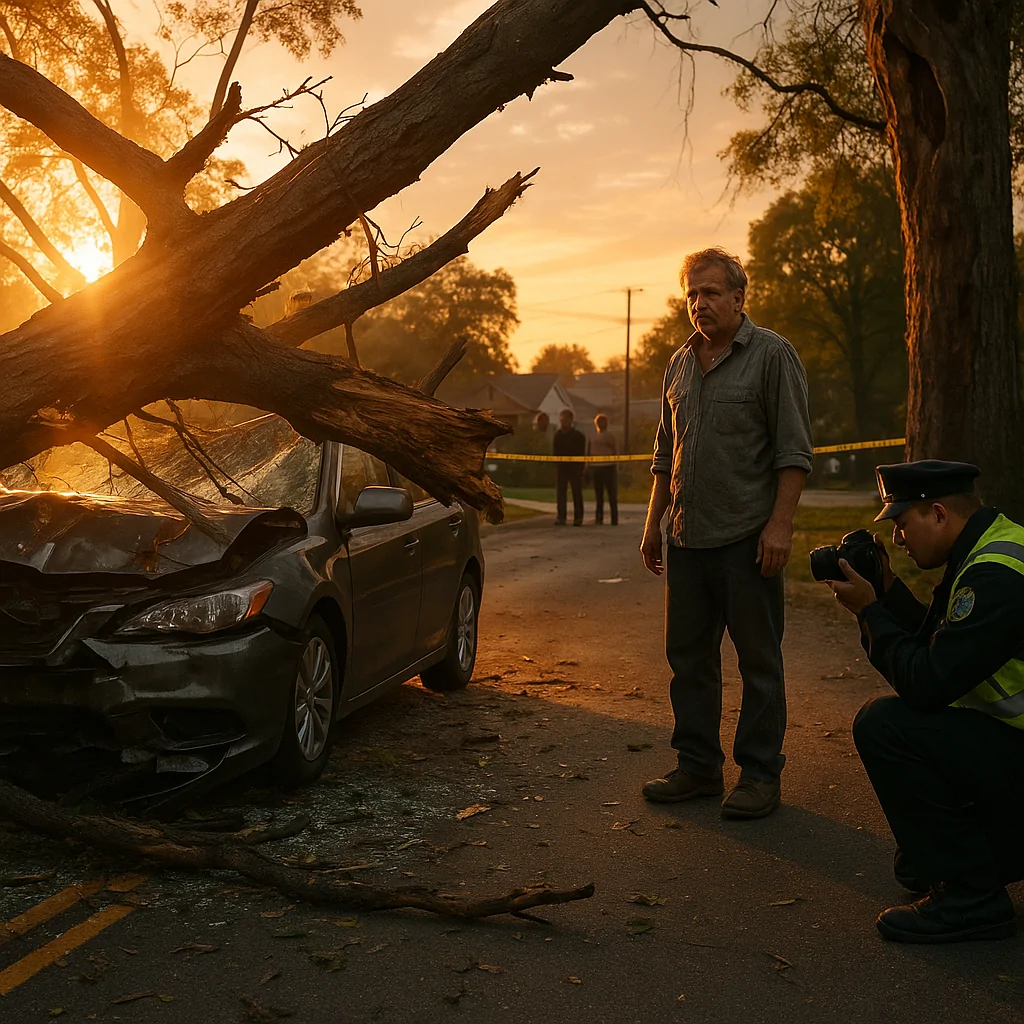
- Hero image caption: “Car crash caused by falling tree branch — document scene immediately.”
- Infographic: “What to do in the first 24 hours” (safety, police, photos, witnesses, medical, preservation).
- Flowchart: Liability pathways—property owner, trucking company, municipality, unknown/act of God.
- Photo examples: Clear vs. poor images of tree decay, cargo tie-downs, and point-of-impact damage (blur plates/faces).
Conclusion
A car crash caused by falling tree branch, spilled cargo, or roadway debris raises unique liability questions involving owners, cities, and motor carriers. Your immediate steps—medical care, police report, photos, witness contacts, and preservation letters—set up your claim for success. Because deadlines and notice rules are strict, act quickly and document everything.
This article is informational only and does not constitute legal advice. Laws vary by state—consult a licensed attorney in your state for case-specific guidance about a claim against property owner falling object or falling object car accident liability.
Need help now? Get a free and instant case evaluation by Visionary Law Group. See if your case qualifies within 30-seconds at https://eval.visionarylawgroup.com/auto-accident.
FAQ
Who is responsible if a tree branch falls from public vs. private property?
For private property, liability depends on notice and maintenance. If the owner knew or should have known a tree was hazardous and failed to act, you may pursue a premises claim; your comprehensive auto insurance may also apply first, as noted by Experian and industry guidance from AplusTree. For public trees, you usually must provide timely notice and prove the city had prior knowledge; see the municipal context and “act of God” discussion at TexasLawHelp.
Can I sue a trucking company if cargo fell and hit my car?
Yes. You can bring a truck cargo fell accident lawsuit against the driver, the motor carrier, and the loader for violating cargo securement standards. The FMCSA rules outline tie-down and inspection requirements. Discovery can reveal policy and training failures that support negligence and vicarious liability.
What if the weather caused the falling object—is it an act of God?
Severe storms may excuse liability if the tree was healthy and there was no reasonable way to anticipate failure. But visible decay, prior complaints, or missed maintenance can defeat the “act of God” defense. The concept is explained in TexasLawHelp’s overview.
How long do I have to file a claim?
Deadlines vary. Many personal injury claims must be filed within 2–3 years; property damage may have 2–4 years; municipal notice can be as short as 30–60 days. Act immediately to preserve rights and consult local law.
What compensation can I seek?
You can claim economic damages (vehicle repairs or total loss, medical bills, lost wages) and non-economic damages (pain and suffering, loss of enjoyment). Injuries from road debris car crash events often require ongoing care—document everything to support full valuation.
For deeper reading on valuation, see our explainer on calculating car crash compensation.