Table of Contents
Estimated reading time: 18 minutes
Key Takeaways
- A bystander injured car crash claim lets pedestrians, cyclists, and people near a crash pursue compensation even if they were not inside a vehicle.
- Medical care, prompt reporting, photographs with preserved metadata, and early witness and video preservation are critical to proving fault and causation.
- Potentially liable parties may include the driver, vehicle owner or employer, manufacturers, property owners, and municipalities—often more than one.
- You must prove duty, breach, causation, and damages; expert reconstruction and medical opinions often resolve disputes about how injuries occurred.
- Compensation can include medical bills, lost income, pain and suffering, and more; timing your claim and resisting early low offers helps protect value.
- Deadlines and special government notice rules vary; consult local counsel quickly to avoid lost rights and to secure legal help for a nearby crash victim.
A bystander injured car crash claim is a personal‑injury claim brought by someone who was not driving but was hurt in or around a vehicle crash — for example, a pedestrian, cyclist, or a person standing on a sidewalk who was struck or otherwise injured because of the collision. This guide explains legal recourse, immediate steps to take after a crash, and when to seek legal help for a nearby crash victim. Recent national data show that pedestrian deaths remain alarmingly high, underscoring the risks to people outside vehicles; see NHTSA’s pedestrian safety overview for current figures and prevention guidance. Read on for an immediate checklist, who can sue, common scenarios (including being hit while on a sidewalk), how claims are proved, compensation types, and how to get legal help for a nearby crash victim.
Immediate steps after a bystander injury at a crash: a quick checklist
This checklist is for anyone who suffered an accident injury outside a vehicle — follow these steps to protect your health and preserve evidence.
- Call 911 and accept EMS/ER care even if you think you’re OK — record the EMS incident number and hospital name. Delayed symptoms are common; let the provider document every area of pain.
- Request the police report and incident number; write down officers’ names and badge numbers at the scene. Later, obtain the full report and keep it with your records.
- Take photos and video from multiple angles: vehicle positions, skid marks, curb/sidewalk relation, debris, street signs, crosswalk markings, lighting, and your visible injuries. Use a date/time stamp when possible, preserve EXIF metadata, and create a cloud backup. Include wide shots for context and close-ups for detail; if you have dashcam footage, secure and copy the original files.
- Collect driver info (name, license plate, insurer/policy) and witnesses (names, phones, brief note of what they saw). Ask witnesses for a short statement while details are fresh.
- Ask nearby homes/businesses about CCTV/doorbell footage and note camera locations; get contact info of owners for later preservation. Request that they retain footage before it auto-overwrites.
- Preserve clothing, shoes, stroller/bike helmet — place in a clean paper bag; photograph them on-scene before moving. Note damage, stains, and location found.
- Do’s and don’ts: Do exchange info and get medical attention. Don’t admit fault, apologize, or give recorded statements to insurers without counsel; don’t sign releases. If offered immediate money, decline and document the offer.
Evidence preservation specifics:
- Time-stamp your photos and keep originals with EXIF data intact; avoid editing files.
- Note lighting, weather, and visibility; photograph streetlights, shadows, and glare.
- Keep a simple chain-of-custody memo: what you collected, when, and who handled items.
- Save phone GPS logs or screenshots showing location and time. Preserve fitness or phone sensor data showing movement and impact where available.
- If a crosswalk or sidewalk was involved (for example, a hit while on sidewalk car accident), capture tire marks on curbs, driveway angles, and sightlines from driver approach.
To deepen your documentation plan, see this practical overview on evidence collection at accident scenes, and consider how dashcam files fit into proof with these tips on using dashcam footage in an accident claim.
Who can file a non-driver car crash lawsuit?
A non‑driver car crash lawsuit is a personal injury action brought by someone who was not operating any motor vehicle involved in the collision but who suffered physical injury as a result of the crash or its immediate aftermath.
Qualifying plaintiffs and plain-language examples
- Pedestrians: people walking, jogging, using mobility devices, standing at bus stops, in crosswalks, or on sidewalks (example: shopper hit while waiting outside a store).
- Bicyclists / micromobility users: cyclists, scooter riders, and skateboarders struck by vehicles or flying debris.
- Bystanders / nearby victims: people hit by flying debris, pushed by vehicles, or struck when a car rolls onto a sidewalk.
- Passengers vs non-drivers: passengers are inside vehicles and often use auto insurance structures differently; non-drivers pursue direct claims for being outside vehicles. If you were a pedestrian hit by a car and seeking compensation, your claim proceeds like other negligence cases even if you were not in a car.
Family claims and bystander emotional distress
If a bystander dies, family often has two civil paths: a wrongful death claim for survivors’ losses and a survival action for the decedent’s pre-death harms. Some states also allow close relatives at the scene to bring separate “bystander emotional distress” claims when witnessing a severe injury or death. For accessible overviews of these doctrines, see explanations of family and bystander claims from Buckfire & Buckfire, a definition of “bystander claim” in IRMI’s insurance glossary, and discussions of negligent infliction of emotional distress for bystanders by LegalMatch and Orlow Law.
Practical tips:
- When tragedy occurs, involve counsel early to preserve scene evidence and manage short government notice deadlines if a public entity is involved.
- Interview close relatives and witnesses promptly while memories are fresh; gather contemporaneous texts, photos, and social posts documenting shock and grief.
- In California-specific matters, learn more about elements and timing through this overview on wrongful death car crash claims.
Who can be sued — drivers, owners, employers, manufacturers, and municipalities
Liability may extend beyond the driver who made the immediate mistake; your attorney will evaluate all parties whose conduct or omissions contributed to your injury.
Driver negligence
Common theories: speeding, DUI, distracted driving, failure to yield, and red‑light running. Evidence can include citations, dashcam clips, smartphone use data, traffic‑signal timing, and witness statements. If a driver mounted a curb into a sidewalk, that often indicates a breach of safe‑driving duties.
Vehicle owner or employer
Owners and employers may be responsible under vicarious liability when a driver was on the job, or under negligent entrustment if they loaned a car to an unsafe driver. Discovery often targets employment records, GPS/dispatch logs, and company safety policies.
Manufacturer or component supplier
Defective brakes, steering, tires, or electronics can cause loss of control. Product-liability claims rely on vehicle inspections, recall records, and engineering analysis. Preserve parts and keep the chain of custody clear so experts can examine components credibly.
Property owner or municipality
Unsafe sidewalks, poor crosswalk design, obstructed sightlines, or missing signage can contribute to a bystander’s harm. Evidence may include maintenance logs, prior complaints, and municipal records. Claims against public entities trigger special notice rules discussed in Section 10.
Multiple defendants and apportionment
Many cases involve shared fault (for example, a speeding driver and a poorly designed driveway crossing). Insurers and juries apportion percentages. Under comparative fault systems, your recovery may be reduced by your share of responsibility; see this primer on comparative negligence for how systems differ.
Key discovery and records to request
- Driving history, citations, and prior crashes.
- Employer contracts, training files, and route or dispatch records.
- Maintenance logs, recall notices, and dealership service records.
- Event data recorder (EDR) downloads and infotainment logs; visit this practical guide on dashcam and video use in claims.
- Municipal complaint logs, design drawings, traffic studies, and signal timing charts.
Common bystander and pedestrian crash scenarios — what to expect
Below are frequent fact patterns with common legal issues and targeted evidence to gather.
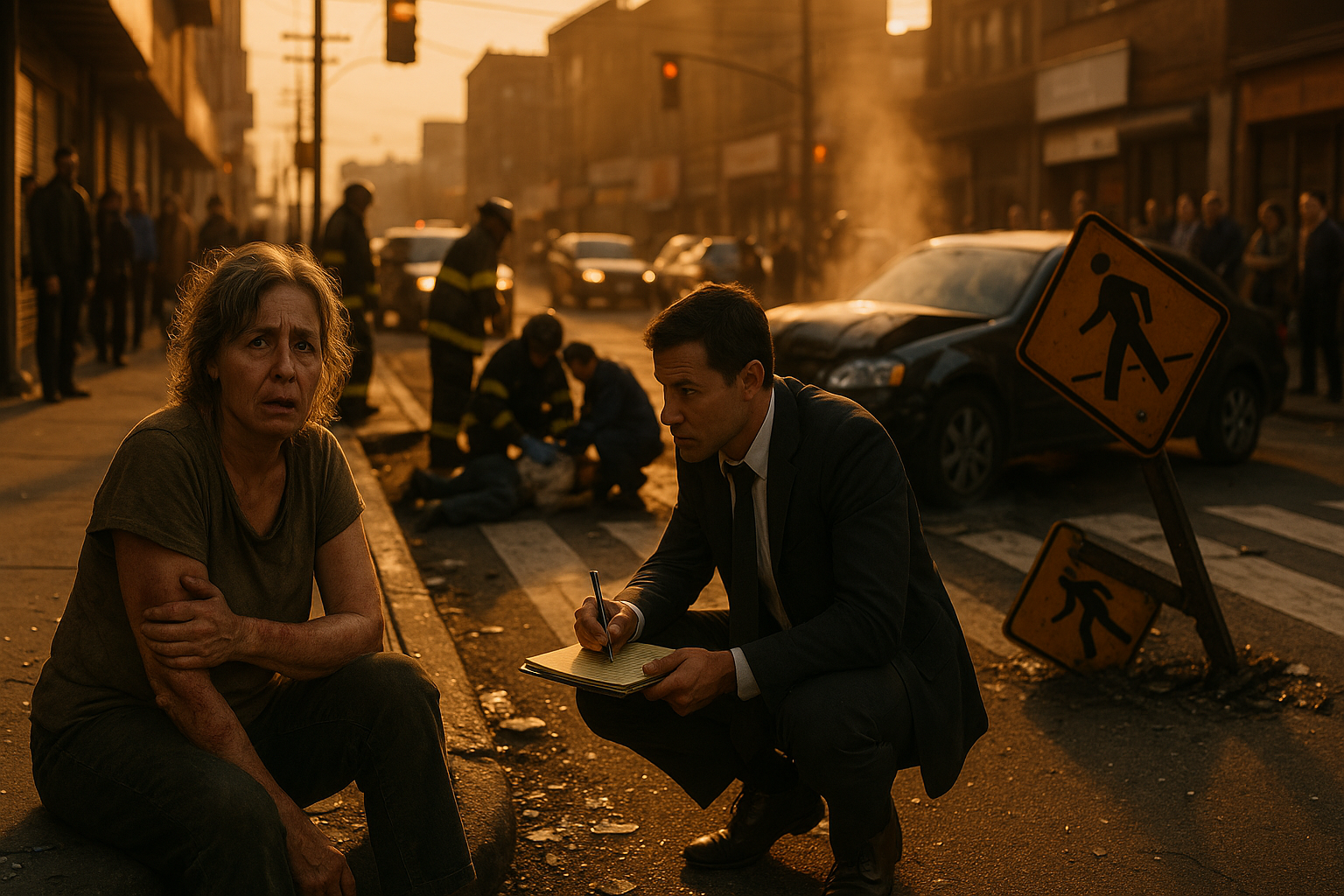
Hit while on sidewalk car accident
Vehicles must stay out of pedestrian spaces. A driver who jumps a curb or crosses a sidewalk without yielding often breaches basic safety duties. Key questions include visibility (line of sight, lighting), driver intent or distraction, and any claim of emergency avoidance.
Evidence to collect:
- Photos of tire marks on the curb, scuffs, and the vehicle’s resting location relative to the sidewalk.
- Video clips from storefronts, homes, and traffic cameras; preserve files quickly before overwrite.
- Witness statements about speed, phone use, or signal violations; request contact information for future interviews.
Common defenses and responses: If a driver claims a sudden medical emergency or evasive maneuver, reconstruction helps test plausibility using speed estimates, path-of-travel analysis, and timing. Plaintiffs typically rely on negligence per se (traffic violations) and standard negligence.
Accident injury outside vehicle (debris, rolling cars, secondary collisions)
An accident injury outside vehicle includes harms caused by crash consequences: flying parts, a vehicle pushed into you, a car rolling after impact, or injuries while jumping away from danger. Causation turns on linking the secondary event to the initial crash via timeline, scene mapping, and expert analysis.
Evidence to collect:
- Debris samples and parts; photograph with scale (coin, ruler), bag and label them, and log custody.
- Surveillance or dashcam showing sequence of impacts and movement.
- Medical records with precise time of injury and mechanism (e.g., “struck by detached wheel”).
These cases still proceed as a non-driver car crash lawsuit because the legal focus is on negligence and foreseeable consequences of the initial breach.
Bystander injured at intersection or construction zone
Intersections and work zones raise issues of signal timing, temporary signage, contractor barriers, and visibility. Defendants may include drivers, contractors, or municipalities. Preserve pre- and post-construction photos, lane closure plans, contractor work orders, and any public complaints. If a government entity is involved, consult local counsel promptly about notice requirements.
Dooring or delivery/ride-service vehicle encroachments
Opening a car door into the path of a pedestrian or cyclist (“dooring”) is widely prohibited by traffic codes. Liability can also arise when delivery trucks or rideshare vehicles pull across sidewalks or into pedestrian zones without yielding. Secure platform records, driver statements, and nearby video; these cases also proceed as a non-driver car crash lawsuit.
How to prove a bystander injured car crash claim — duty, breach, causation, and damages
To win, you must prove four elements:
- Duty: “A legal obligation to act reasonably (drivers must operate safely; property owners must maintain safe premises).”
- Breach: “A violation of that duty — e.g., speeding, running signals, failing to maintain a sidewalk.”
- Causation: “A showing that the breach was a substantial factor in causing your injury (actual cause and proximate cause).”
- Damages: “Actual losses (medical bills, lost wages) and non‑economic harms (pain, emotional distress).”
Key evidence checklist and how to get it
- Police report: Request a copy, note the report number, and save a digital copy with a clear file name (date-location-report#). Officer diagrams often become anchors for reconstruction.
- Medical records: Build a timeline of care from EMS through discharge and follow-up. Tell every provider the crash caused your symptoms; keep all bills, CPT codes, and pharmacy receipts.
- Photos/videos: Follow a date/time-stamp policy. Request CCTV promptly before overwrite; preserve original files and EXIF data.
- Witness statements: Capture contact details and brief notes. With consent, consider short audio-recorded statements; preserve originals securely.
- Expert evidence: Accident reconstructionists analyze speed, trajectories, points of impact, and visibility. Medical experts link injuries to the crash and provide future care needs. Life-care planners and vocational experts help value long-term losses.
Causation specifics: acute vs delayed symptoms
Some harms—fractures and lacerations—are obvious. Others emerge later: concussions, soft‑tissue injuries, and internal damage can appear hours or days afterward. Schedule early follow‑ups, report new or worsening symptoms, and avoid gaps in care. Insurers often challenge delayed reporting; objective imaging, consistent complaints, and specialist notes help counter these arguments.
Common defenses and how to rebut them
- Comparative negligence: Defendants may argue you were inattentive, outside a crosswalk, or moved unexpectedly. Use objective evidence (signal timing, video, measurements) and witness accounts to set the record straight. Review this guide to comparative negligence systems when evaluating shared fault arguments.
- Assumption of risk and superseding causes: Document conditions that undermine these defenses, such as a driver’s statutory violations or foreseeability of secondary impacts in a multi-car event.
Sources on emotional/bystander claims: For accessible explanations and definitions used by courts and insurers, see Buckfire & Buckfire, Orlow Law on bystander emotional distress, IRMI’s bystander claim definition, and LegalMatch’s overview of bystander NIED.
What compensation can injured bystanders recover?
When a non‑driver car crash lawsuit resolves by settlement or verdict, recoverable damages may include:
Economic damages
- Medical bills: EMS/ambulance, ER, imaging (CT/MRI), specialist visits, surgery, hospital stays, rehabilitation, prescriptions, and medical equipment (crutches, braces, wheelchairs). Consider future medical projections supported by treating doctors or life‑care planners.
- Home and vehicle modifications: Ramps, handrails, or adaptive devices if needed.
- Lost wages and reduced earning capacity: Use W‑2/1099s, pay stubs, employer verification, and, if needed, vocational assessments.
Non‑economic damages
- Pain and suffering, emotional distress, PTSD, sleep disruption, and loss of enjoyment of life. Insurers sometimes apply “multiplier” or “per‑diem” approaches, though methods vary by jurisdiction; see this California-focused primer on pain and suffering valuation.
Special damages and out-of-pocket losses
- Property damage: phone, glasses, bicycle, stroller, clothing, or other personal items.
- Out-of-pocket costs: travel to medical visits, co-pays, deductibles, home health aides, childcare, or caregiver support. Keep receipts and mileage logs.
Punitive damages
Punitive awards punish egregious conduct like DUI or intentional harm. They are rare and vary by state. Ask your attorney whether punitive exposure exists based on facts and local law.
Document checklist to prove each item
- Bills and EOBs, pharmacy printouts, and therapy attendance records.
- Pay stubs, tax returns, employer statements, and disability forms.
- Receipts for travel, medical devices, caregiving, and home changes.
- Pain diaries, sleep logs, and mental health treatment notes (when appropriate).
Insurance claims vs. a lawsuit — when to settle and when to litigate
Immediate reporting and coverage options
- Notify the police and request a report number. Time and accuracy matter.
- Inform your own insurer for MedPay/PIP and UM/UIM coverage where applicable; your health insurance may also cover care subject to coordination of benefits and liens.
- Be cautious with adjusters: recorded statements and broad medical authorizations can harm your case. See communication tips in this guide to dealing with insurance adjusters.
Settlement timing
Settling after treatment stabilizes (maximum medical improvement) usually leads to more accurate valuations. Early, low offers are common—do not assume the first number reflects full losses. For an end‑to‑end view of the process, review this compensation claims process guide.
Lawsuit triggers
- Liability disputes, finger‑pointing among multiple parties, or missing video/witnesses.
- Inadequate offers that ignore pain, future care, or reduced earning capacity.
- Statute of limitations approaching (see deadline guidance below).
Statute of limitations and special deadlines
Deadlines vary widely by state and defendant type (individual vs government). Many public entities impose short notice periods measured in months, not years. Do not rely on general timelines—speak with local counsel promptly and review this primer on insurance claim time limits.
Contingency fee basics
Most injury attorneys work on a contingency fee (no upfront fees, a percentage of the recovery, costs advanced and repaid from any recovery). Ask about percentage tiers, how costs are handled, and what happens if there is no recovery.
How an attorney can help a nearby crash victim
Securing legal help for a nearby crash victim can be the difference between an underpaid claim and a fair, well‑documented recovery.
Investigation and preservation
- Send preservation letters to businesses and homeowners to save CCTV and doorbell video.
- Obtain police, EMS, and medical records and align them into a single timeline.
- Inspect the vehicle and scene; download EDR; retain reconstruction, biomechanical, and medical experts as needed.
Negotiation and litigation
- Engage adjusters, respond to low offers, and structure settlements to account for future care and liens.
- When needed, file suit, conduct depositions, handle motions, and prepare for trial.
What to bring to an initial consult
- Police report or incident number, photos/videos, and a list of witnesses’ contact info.
- All medical records and bills (or provider list), plus health/auto insurance cards.
- Letters, emails, texts, and voicemails from any insurer or investigator.
- A list of missed work dates, employer contact, and any disability forms.
Questions to ask at consult
- “How many pedestrian or bystander cases have you handled?”
- “What is your typical fee and how are costs handled if there is no recovery?”
- “Who will handle day‑to‑day communications?”
If your injuries occurred as a pedestrian, this California-focused guide to hiring the right counsel can help you frame next steps: Hiring a California pedestrian accident attorney.
What affects the value of your bystander claim — factors and example scenarios
Key factors that often drive value
- Injury severity and permanence: sprains and bruises vs. fractures, surgeries, or traumatic brain injury.
- Clarity of fault: a drunk driver on the sidewalk typically increases settlement leverage; disputed liability often suppresses offers.
- Comparative fault: assigned percentages can reduce payouts; understand how your state’s rules apply using this comparative negligence primer.
- Policy limits and assets: liability, umbrella, and UM/UIM coverages all influence practical recovery.
- Impact on work and daily life: time away from work, missed caregiving duties, and activity restrictions; document with employer letters and daily function logs.
Numbers are illustrative only; consult counsel.
Example 1: Hit while on sidewalk car accident
Facts: A driver speeds, jumps the curb, and strikes a person waiting with groceries. Injuries: compound tibia fracture requiring surgery, hardware, and months of therapy. Medical bills might reach tens of thousands; total settlement can vary widely (from low five figures into mid-six figures) depending on insurance limits, comparative fault disputes, and long‑term impairment. Highly variable — depends on jurisdiction, insurance, and facts.
Example 2: Struck by debris — accident injury outside vehicle
Facts: In a two‑car crash, a wheel detaches and hits a bicyclist on the shoulder. Injuries: concussion and rotator cuff tear with persistent overhead limitations. Medical costs may range into the tens of thousands; product vs driver fault, defect evidence, and future care drive additional value. If a defect is proven, product‑liability exposure can change negotiations significantly.
State‑specific issues to watch for
- Comparative negligence systems: In pure systems, your recovery is reduced by your percentage of fault even if you are mostly at fault. In modified systems, recovery may be barred at a threshold (often 50% or 51%). See an overview of how systems differ in this guide to comparative negligence.
- Municipal notice requirements: Many public entities require written notice within short windows and specific content (date, location, injury description). Missing these can bar claims; act fast if a city, county, or state agency may be involved.
- Damage caps and punitive damages: Some states cap non‑economic or punitive damages. Confirm local rules before valuing the case.
- Expert affidavits or early expert thresholds: Certain jurisdictions require early expert support for specific claim types; consult counsel early to meet technical requirements.
Legal disclaimer and recommended next steps
This article provides general information about bystander and non‑driver car crash claims. It is not legal advice and does not create an attorney‑client relationship. Laws vary by state and by the facts of each case. Consult a qualified attorney in your area for advice about your situation.
Recommended next steps:
- Preserve evidence immediately (photos, video, debris, clothing, receipts).
- Seek prompt medical care and follow up on delayed symptoms.
- Consult local counsel quickly to protect deadlines and notice requirements.
- Keep a dedicated folder (digital and physical) for reports, bills, and communications.
Conclusion
You do not have to be inside a car to be a traffic-crash victim. If you were a pedestrian, cyclist, or bystander near a collision, the law gives you a path to pursue compensation for your medical care, lost income, and pain and suffering. Early medical attention, careful documentation, and timely legal guidance will help you connect the dots between the crash and your injuries, withstand insurer tactics, and hold every responsible party accountable. When you are ready to talk through your options and timing, experienced counsel can guide you step by step and help you decide when to settle and when to litigate.
Need help now? Get a free and instant case evaluation by Visionary Law Group. See if your case qualifies within 30-seconds at https://eval.visionarylawgroup.com/auto-accident.
FAQ
Can a bystander injured in a crash sue the driver?
Yes. If a driver’s negligence caused your injuries as a bystander or pedestrian, you can generally pursue compensation for medical bills, lost wages, and pain and suffering. Some states also allow close family members who witness a serious injury or death to bring separate emotional distress claims; see these plain‑language sources: Buckfire & Buckfire, Orlow Law, IRMI, and LegalMatch.
How long do I have to file a non‑driver car crash lawsuit?
It depends on your state and whether a government entity is involved. Some claims require written notice within months, not years. To protect your rights, contact local counsel immediately and review this overview of insurance claim time limits while you plan your next steps.
What should I do at the scene if I’m a pedestrian injured in a crash?
Call 911 and accept EMS care, get a police report and incident number, and photograph the scene and your injuries from multiple angles. Collect driver and witness information, ask nearby businesses to preserve CCTV, and store clothing/gear in a paper bag as evidence. Do not admit fault or give recorded statements to insurers. These steps apply whether you were in a hit while on sidewalk car accident or suffered an accident injury outside vehicle.
If I was hit while on a sidewalk, is the driver automatically at fault?
Not automatically, but drivers owe strong duties to keep vehicles out of pedestrian zones, and curb encroachments commonly indicate negligence. Insurers may still investigate visibility, speed, emergency maneuvers, and your movements. Photos, video, and witness accounts help clarify how the hit while on sidewalk car accident occurred and who breached safety rules.
What types of compensation can a bystander injured in a car crash receive?
Compensation may include economic losses (medical bills, lost income), non‑economic damages (pain and suffering), special damages (out‑of‑pocket costs and property losses), and, in limited cases, punitive damages. See the damages breakdown above and this companion guide to valuing pain and suffering for more detail on documentation and valuation in a bystander injured car crash claim.